Paid Vacation by Country: Minimum Annual Leave in 28 Laws
On this page
A team lead in Berlin plans next year with colleagues in Lyon, Lisbon and Austin. Someone asks the simple question: what is the legal minimum of paid vacation for each of them? The first page of Google answers with rankings that mix calendar days, six-day weeks and public holidays into one number, and cite nobody’s law.
So we read the laws. 28 countries, each from its own statute or government page, quoted, with the unit the law uses and whether public holidays sit inside the leave.
Short answer: the United States has no legal minimum of paid vacation. EU law sets four weeks (20 working days on a 5-day week), and most of Europe stays there. Austria, Denmark, Finland, France and Sweden give five weeks (25 working days). Portugal gives 22 working days. The UK gives 28 days, but an employer may count the 8 bank holidays inside them. Australia and New Zealand give four weeks; Japan and federally regulated employers in Canada give 10 working days after the first year; Singapore 7; China 5. Public holidays are a separate count, shown in their own column below.
This page explains what the laws say, as checked on 14 November 2026. It is not legal advice: check the law of your country, a collective agreement and the employment contract, which can only add to these minimums.
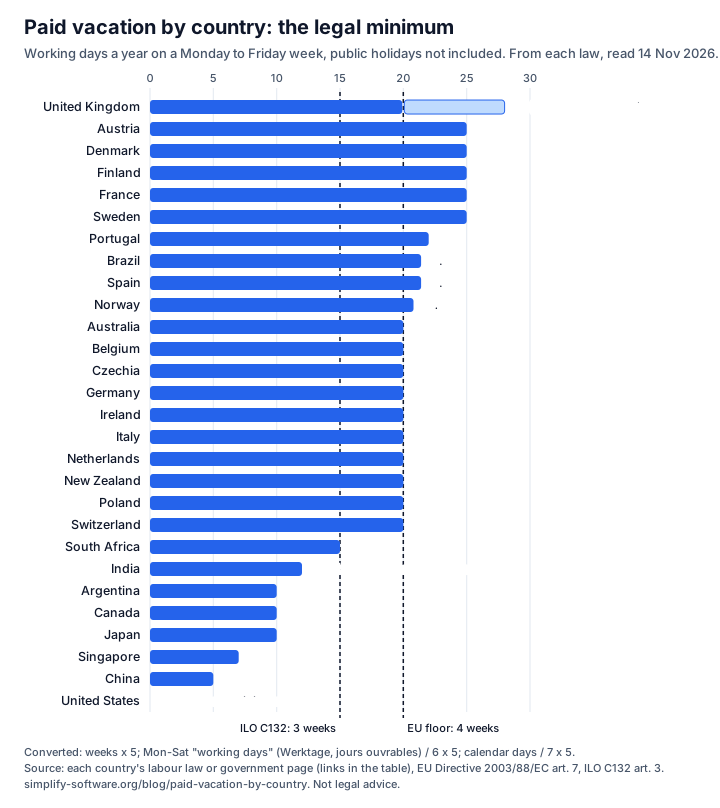
The table: 28 countries, ranked
Each country name links to the law or the government page we read. “Working days” converts the law’s own unit to a Monday to Friday week, so a row from Germany and a row from Spain mean the same thing. “Holidays inside?” says whether the quoted law lets a public holiday in the middle of the leave use up a leave day: No, May be (the UK), or Not stated. “Public holidays 2027” counts the national holidays that fall on a weekday in 2027 (our public holidays 2027 list) and is never added to the leave.
| # | Country and law | Minimum, as written | Working days (5-day week) | Holidays inside? | Public holidays 2027 | Checked |
|---|---|---|---|---|---|---|
| 1 | United Kingdom | 5.6 weeks | 28 | May be | 8 | |
| 2 | Austria | 30 Werktage | 25 | Not stated | 9 | |
| 3 | Denmark | 2.08 days a month | 25 | No | 6 | |
| 4 | Finland | 30 arkipäivää (2.5 a month) | 25 | No | 6 | |
| 5 | France | 30 jours ouvrables | 25 | No | 7 | |
| 6 | Sweden | 25 semesterdagar | 25 | No | 5 | |
| 7 | Portugal | 22 dias úteis | 22 | No | 8 | |
| 8 | Brazil | 30 dias corridos | 21.4 | Not stated | 7 | |
| 9 | Spain | 30 días naturales | 21.4 | Not stated | 7 | |
| 10 | Norway | 25 virkedager | 20.8 | No | 6 | |
| 11 | Australia | 4 weeks | 20 | No | 9 | |
| 12 | Belgium | 4 weeks | 20 | Not stated | 10 | |
| 13 | Czechia | 4 týdny | 20 | Not stated | 9 | |
| 14 | Germany | 24 Werktage | 20 | No | 5 | |
| 15 | Ireland | 4 working weeks | 20 | Not stated | 8 | |
| 16 | Italy | 4 weeks | 20 | Not stated | 7 | |
| 17 | Netherlands | 4 x weekly hours | 20 | Not stated | 5 | |
| 18 | New Zealand | 4 weeks | 20 | Not stated | 11 | |
| 19 | Poland | 20 dni | 20 | Not stated | 8 | |
| 20 | Switzerland | 4 Wochen | 20 | Not stated | not listed | |
| 21 | South Africa | 21 consecutive days | 15 | No | 10 | |
| 22 | India | 1 day per 20 worked | about 12 | Not stated | 11 | |
| 23 | Argentina | 14 días corridos | 10 | Not stated | 12 | |
| 24 | Canada | 2 weeks | 10 | Not stated | 10 | |
| 25 | Japan | 10 working days | 10 | Not stated | 16 | |
| 26 | Singapore | 7 days | 7 | Not stated | 8 | |
| 27 | China | 5 days | 5 | No | 18 | |
| 28 | United States | none | 0 | No law | 12 |
Where a law grows with service, the table shows the first full year: Austria rises to six weeks after 25 years, Poland to 26 days after 10, Canada to three weeks after 5 years and four after 10, Japan to 20 days, Singapore to 14, China to 15 and Argentina to 35 calendar days.
How to read a leave law
Five questions turn any of these laws into a number you can put in a policy.
- What unit does it count in? Four are in use. Weeks (the EU directive, the UK, Italy, Ireland, Australia): multiply by the days a person works in a week. Working days on a 5-day week (Portugal’s dias úteis, Sweden’s semesterdagar, Japan): take them as they are. “Working days” that include Saturday (Germany’s and Austria’s Werktage, France’s jours ouvrables, Norway’s virkedager, Finland’s arkipäivät): divide by 6 and multiply by 5, so 24 Werktage are 20 days and 30 jours ouvrables are 25. Calendar days (Spain’s días naturales, Argentina’s and Brazil’s días corridos, South Africa’s 21 consecutive days): weekends inside the leave count, so divide by 7 and multiply by 5.
- Are public holidays inside it? Usually not. Germany’s law counts only “Kalendertage, die nicht Sonn- oder gesetzliche Feiertage sind”, Portugal’s dias úteis exclude feriados, and Australia says an employee “is taken not to be on paid annual leave on that public holiday”. The UK is the exception that changes the ranking.
- When is it earned? France earns 2.5 jours ouvrables a month, Finland 2.5 arkipäivää, Denmark 2.08 days. Belgium pays this year’s leave on last year’s work, so a first job gives little in year one. New Zealand starts after 12 months, Japan after 6.
- Does it grow with service? In Austria, Poland, Canada, Japan, Singapore, China and Argentina, yes. In most of the EU, no: the floor is the floor.
- Is it a floor or a typical number? Every number here is a floor. Collective agreements give far more in some countries, and US employers give paid vacation without any law: 11 days after one year on average, says the BLS data in our PTO benchmarks.
Three numbers page 1 gets wrong
The UK’s 28 days. GOV.UK says most workers on a 5-day week “must receive at least 28 days’ paid annual leave a year”, and also: “An employer can choose to include bank holidays as part of a worker’s statutory annual leave.” With the 8 bank holidays of England and Wales inside, 20 days are left to choose. That is the EU floor, not the top of the table.
The US “10 days”. A ranking that gives the US 10 or 11 days counts the federal holidays. Those are paid days off for federal employees. For a private employer, the Department of Labor is plain: the Fair Labor Standards Act “does not require payment for time not worked, such as vacations, sick leave or federal or other holidays”. The legal minimum is zero.
France’s “31 days”. One ranking on page 1 lists France with 31 days of paid leave. The law gives 30 jours ouvrables, which Service-Public.fr spells out as “5 semaines”. On a Monday to Friday week that is 25 days, the same as Sweden.
The law, quoted
Open a country for the sentence we used, an English translation where the law is not in English, and the link. Every row was checked on 14 November 2026.
Europe
United Kingdom: 5.6 weeks, 28 working days
Most workers who work a 5-day week must receive at least 28 days’ paid annual leave a year. ... An employer can choose to include bank holidays as part of a worker’s statutory annual leave.Capped at 28 days. With the 8 bank holidays of England and Wales inside, 20 days are left to choose. Source: Statutory holiday entitlement (GOV.UK), checked 2026-11-14.
Austria: 30 Werktage, 25 working days
Das Urlaubsausmaß beträgt bei einer Dienstzeit von weniger als 25 Jahren 30 Werktage und erhöht sich nach Vollendung des 25. Jahres auf 36 Werktage.In English: Leave is 30 working days with less than 25 years of service and rises to 36 working days after the 25th year.
Five weeks; six after 25 years of service. Source: Urlaubsgesetz § 2, checked 2026-11-14.
Denmark: 2.08 days a month, 25 working days
Retten til betalt ferie optjenes med 2,08 dage for hver måneds ansættelse i ferieåretIn English: Paid leave is earned at 2.08 days for each month of employment in the holiday year.
12 months x 2.08 = 25 days. Leave cannot be held on public holidays (§ 6). Source: Ferieloven § 5, checked 2026-11-14.
Finland: 30 arkipäivää (2.5 a month), 25 working days
Työntekijällä on oikeus saada lomaa kaksi ja puoli arkipäivää kultakin täydeltä lomanmääräytymiskuukaudelta.In English: The employee earns two and a half working days of leave for each full month.
Two days a month in the first year. Arkipäivä excludes Sundays and church holidays but includes Saturdays. Source: Vuosilomalaki 5 §, checked 2026-11-14.
France: 30 jours ouvrables, 25 working days
le salarié bénéficie de 2,5 jours ouvrables par mois de travail effectif chez le même employeur. Cela correspond à 30 jours ouvrables (5 semaines) pour une année complète de travail.In English: The employee earns 2.5 working days per month of actual work with the same employer. That is 30 working days (5 weeks) for a full year of work.
Jours ouvrables are every day except the weekly rest day and the public holidays the company does not work. Source: Congés payés (Service-Public.fr, Premier ministre), checked 2026-11-14.
Sweden: 25 semesterdagar, 25 working days
En arbetstagare har rätt till tjugofem semesterdagar varje semesterår.In English: An employee is entitled to twenty-five vacation days each vacation year.
Saturdays, Sundays and public holidays are not vacation days (3 a §). Source: Semesterlag (1977:480) 4 §, checked 2026-11-14.
Portugal: 22 dias úteis, 22 working days
1 - O período anual de férias tem a duração mínima de 22 dias úteis. 2 - Para efeitos de férias, são úteis os dias da semana de segunda-feira a sexta-feira, com excepção de feriados.In English: Annual leave is at least 22 working days. Working days are Monday to Friday, except public holidays.
The highest floor written in Monday to Friday days in this table. Source: Código do Trabalho, artigo 238, checked 2026-11-14.
Spain: 30 días naturales, 21.4 working days
En ningún caso la duración será inferior a treinta días naturales.In English: In no case shall it be shorter than thirty calendar days.
Calendar days: a weekend inside the leave counts. 30 days are 4 weeks and 2 days. Source: Estatuto de los Trabajadores, artículo 38, checked 2026-11-14.
Norway: 25 virkedager, 20.8 working days
Arbeidsgiver plikter å sørge for at arbeidstaker gis feriefritid på 25 virkedager hvert ferieår. ... Som virkedager regnes alle dager som ikke er søndager eller lovbestemte helge- eller høytidsdager.In English: The employer must give the employee 25 working days off each holiday year. Working days are all days that are not Sundays or public holidays.
Virkedager include Saturdays: four weeks and one day. Source: Ferieloven § 5, checked 2026-11-14.
Belgium: 4 weeks, 20 working days
Le nombre maximal de jours de vacances légaux auxquels vous pouvez avoir droit est fixé à 24 jours de travail par an dans le cas d’une occupation s’inscrivant dans le régime de la semaine de six jours ou à 4 semaines de vacances par an dans n’importe quel régime.In English: The most legal leave you can have is 24 working days a year on a six-day week, or 4 weeks a year on any work pattern.
Earned on the previous year’s work, so a first job brings little or no paid leave in year one. Source: Office national des vacances annuelles (ONVA), checked 2026-11-14.
Czechia: 4 týdny, 20 working days
Výměra dovolené činí nejméně 4 týdny v kalendářním roce.In English: Leave is at least 4 weeks in a calendar year.
Five weeks in the public sector, eight for teachers. Source: Zákoník práce, § 212, checked 2026-11-14.
Germany: 24 Werktage, 20 working days
(1) Der Urlaub beträgt jährlich mindestens 24 Werktage. (2) Als Werktage gelten alle Kalendertage, die nicht Sonn- oder gesetzliche Feiertage sind.In English: Leave is at least 24 working days a year. Working days are all calendar days that are not Sundays or public holidays.
Werktage include Saturdays, so 24 of them are four weeks. Source: Bundesurlaubsgesetz § 3, checked 2026-11-14.
Ireland: 4 working weeks, 20 working days
4 working weeks in a leave year in which he or she works at least 1,365 hours (unless it is a leave year in which he or she changes employment)Public holidays are a separate entitlement in section 21. Source: Organisation of Working Time Act 1997, section 19, checked 2026-11-14.
Italy: 4 weeks, 20 working days
il prestatore di lavoro ha diritto ad un periodo annuale di ferie retribuite non inferiore a quattro settimane.In English: The worker is entitled to a yearly period of paid leave of no less than four weeks.
At least two of the weeks are taken in the year they are earned. Source: Decreto legislativo 66/2003, articolo 10, checked 2026-11-14.
Netherlands: 4 x weekly hours, 20 working days
aanspraak op vakantie van ten minste vier maal de overeengekomen arbeidsduur per weekIn English: entitled to leave of at least four times the agreed working hours per week
Counted in hours: a 40-hour week gives 160 hours. Source: Burgerlijk Wetboek, Boek 7, artikel 634, checked 2026-11-14.
Poland: 20 dni, 20 working days
20 dni na rok kalendarzowy ... 26 dni na rok kalendarzowy ... Urlop jest udzielany w dniach, które dla pracownika są dniami pracy w wymiarze godzinowym.In English: 20 days a calendar year (under 10 years of service), 26 days (10 years or more). Leave is given on the days that are working days for the employee.
26 days after 10 years; school and university years count toward the 10. Source: Kodeks pracy, art. 154 (Biznes.gov.pl), checked 2026-11-14.
Switzerland: 4 Wochen, 20 working days
Der Arbeitgeber hat dem Arbeitnehmer jedes Dienstjahr wenigstens vier Wochen, dem Arbeitnehmer bis zum vollendeten 20. Altersjahr wenigstens fünf Wochen Ferien zu gewähren.In English: The employer must give at least four weeks of leave each year of service, and at least five weeks to employees up to age 20.
Only 1 August is a federal holiday; the cantons set the rest. Source: Obligationenrecht, Art. 329a, checked 2026-11-14.
Americas
Brazil: 30 dias corridos, 21.4 working days
Length of holiday specified: 30 calendar days.After 12 months of work, fewer days after many absences. The text of the CLT on planalto.gov.br did not load on 14 November, so this row uses Brazil’s own declaration to the ILO. Source: CLT art. 130, as declared to the ILO under Convention 132, checked 2026-11-14.
Argentina: 14 días corridos, 10 working days
a) De catorce (14) días corridos cuando la antigüedad en el empleo no exceda de cinco (5) años.In English: (a) Fourteen calendar days when service does not exceed five years.
21 days after 5 years, 28 after 10, 35 after 20. Source: Ley de Contrato de Trabajo, artículo 150, checked 2026-11-14.
Canada: 2 weeks, 10 working days
(a) at least two weeks if they have completed at least one year of employment; (b) at least three weeks if they have completed at least five consecutive years of employment with the same employer; and (c) at least four weeks if they have completed at least 10 consecutive years of employment with the same employer.Federally regulated employers only; each province sets the minimum for everyone else. Source: Canada Labour Code, section 184 (federal), checked 2026-11-14.
United States: none, 0 working days
[The FLSA] does not require payment for time not worked, such as vacations, sick leave or federal or other holidays.No federal minimum. Paid vacation is up to the employer or a contract; a few states and cities require paid sick or paid leave. Source: Fair Labor Standards Act (US Department of Labor), checked 2026-11-14.
Asia and Pacific
Australia: 4 weeks, 20 working days
For each year of service with an employer (other than periods of employment as a casual employee of the employer), an employee is entitled to: (a) 4 weeks of paid annual leave; or (b) 5 weeks of paid annual leave, if ...Five weeks for shiftworkers. A public holiday inside the leave is not leave (section 89). Source: Fair Work Act 2009, section 87, checked 2026-11-14.
New Zealand: 4 weeks, 20 working days
After the end of each completed 12 months of continuous employment, an employee is entitled to not less than 4 weeks’ paid annual holidays.Earned after the first 12 months of work. Source: Holidays Act 2003, section 16, checked 2026-11-14.
India: 1 day per 20 worked, about 12 working days
(i) that he has worked one hundred and eighty days or more in such calendar year; (ii) that he shall be entitled for one-day leave for every twenty days of his workIn force since 21 November 2025. About 12 days for 240 days worked. Shops and offices may also fall under a state law. Source: Occupational Safety, Health and Working Conditions Code 2020, section 32, checked 2026-11-14.
Japan: 10 working days, 10 working days
An employer must grant paid leave of 10 consecutive or nonconsecutive working days to a worker who has been employed continuously for 6 months from the day of their hiring and who has reported to work on at least 80 percent of the total working days.Rises with service, up to 20 days after 6.5 years. Source: Labor Standards Act, Article 39, checked 2026-11-14.
Singapore: 7 days, 7 working days
(a) 7 days of paid annual leave, for the first 12 months of continuous service with the same employer; (b) subject to paragraph (c), an additional one day of paid annual leave, for every subsequent 12 months of continuous service with the same employer; (c) a maximum of 14 days of paid annual leave.One more day each year of service, up to 14. Source: Employment Act, section 88A, checked 2026-11-14.
China: 5 days, 5 working days
职工累计工作已满1年不满10年的,年休假5天;已满10年不满20年的,年休假10天;已满20年的,年休假15天。国家法定休假日、休息日不计入年休假的假期。In English: Employees with 1 to 10 years of total work get 5 days, 10 to 20 years 10 days, 20 years or more 15 days. Public holidays and rest days are not counted as annual leave.
Years count over the whole career, not with one employer. Source: Regulations on Paid Annual Leave of Employees, Article 3, checked 2026-11-14.
Africa
South Africa: 21 consecutive days, 15 working days
An employer must grant an employee at least ... (a) 21 consecutive days’ annual leave on full remuneration in respect of each annual leave cycle; or (b) by agreement, one day of annual leave on full remuneration for every 17 days on which the employee worked or was entitled to be paidThree weeks. A public holiday inside the leave adds a day (section 20(8)). Source: Basic Conditions of Employment Act 1997, section 20, checked 2026-11-14.
The two floors above the national laws
The EU. Article 7 of the Working Time Directive 2003/88/EC says: “Member States shall take the measures necessary to ensure that every worker is entitled to paid annual leave of at least four weeks”. It also forbids paying the leave out while the job lasts: the minimum “may not be replaced by an allowance in lieu, except where the employment relationship is terminated.” Every EU country in the table meets four weeks; five go further.
The ILO. Convention 132 sets “three working weeks for one year of service” and keeps public holidays out of it. Only 39 countries have ratified it. From our table: Belgium, Brazil, Czechia, Finland, Germany, Ireland, Italy, Norway, Portugal, Spain, Sweden and Switzerland. The US, the UK, France, the Netherlands, Canada, Australia, Japan, China and India have not.
Keeping track for a team in several countries
The law gives a floor; the team still needs one place that shows who has how many days left and who is out next week. Our app OutSync runs leave requests and approvals inside Jira and Confluence with live balances. Today the yearly allowance is one org-wide number of days, with half days and a carryover cap, so a team spread over countries with different minimums sets it to the policy it actually offers. Its Advanced plan excludes public holidays from a request for a team’s region, currently US, GB or DE; other countries’ holidays are not built in.
For the per-period arithmetic, the PTO accrual calculator turns a yearly allowance into days per pay period. For the holidays themselves, see public holidays 2027 and, for keeping sick days apart from vacation, sick vs vacation leave.
How we built this table
- Every row comes from the law itself or the government’s own page, fetched on 14 November 2026, and quotes the sentence that sets the number. Wikipedia and published rankings were used only to find the laws, never as a source.
- Three sources could not be read directly that day. Legifrance showed a bot check, so France uses Service-Public.fr, the government’s own guide. Planalto.gov.br sent every request to its home page, so Brazil uses the length Brazil declared to the ILO. Poland’s ISAP refused the download, so Poland uses the government business portal Biznes.gov.pl, which cites the Labour Code. India’s Code is quoted from the gazette text published by PRS Legislative Research, with its start date from the government’s press release of 21 November 2025.
- Mexico and South Korea are left out: their official law sites did not respond on the day.
- The conversion: weeks times 5; six-day working days divided by 6 times 5; calendar days divided by 7 times 5; India at about 240 days worked a year. Results are rounded to one decimal.
- Canada’s row is the federal Labour Code, which covers federally regulated employers; provinces set the minimum for everyone else.
Related reading
Frequently asked questions
Which country has the most paid vacation days?
Of the 28 countries we read, the UK has the biggest number, 28 days for a 5-day week, but an employer may count the 8 bank holidays inside it. Austria, Denmark, Finland, France and Sweden give 25 working days, five weeks, with public holidays on top. Worldwide rankings put some Middle East and African countries higher; we have not checked those laws.
Does the USA have paid vacation by law?
No. No federal law requires paid vacation or paid holidays for private employers. The Department of Labor says the Fair Labor Standards Act "does not require payment for time not worked, such as vacations, sick leave or federal or other holidays". In practice, the Bureau of Labor Statistics found an average of 11 paid vacation days after one year in private industry in March 2026.
Which countries have the least paid vacation days?
In our table: the United States (no minimum), China (5 days for 1 to 10 years of total work), Singapore (7 days in the first year), then Japan, Argentina and federally regulated employers in Canada at 10 working days. All of them add days with years of service.
Do Europeans get 3 months of vacation?
No. EU law sets a floor of four weeks of paid annual leave, which is 20 working days. Five countries in our table go to five weeks by law: Austria, Denmark, Finland, France and Sweden. Public holidays come on top, between 5 and 10 weekdays in 2027 for the EU countries we list, and collective agreements often add more. Three months is not a legal minimum anywhere in our table.
Do public holidays count as vacation days?
In most of the laws we read, no. Germany, France, Finland, Norway, Sweden, Denmark, Portugal, Australia, China and South Africa keep public holidays out of the leave, and ILO Convention 132 says they "shall not be counted as part of the minimum annual holiday with pay". The UK is the big exception: an employer may include bank holidays in the 28 days.
Is the minimum the same for part-time workers?
The weeks are the same; the days shrink with the working week. Four weeks for someone who works 3 days a week is 12 days. That is why laws written in weeks (the EU directive, the UK, Australia, the Netherlands) are the easiest to apply to part-time staff.