FREE TOOL · BILLING FROM 3 DECEMBER 2026
Jira automation steps and Rovo credits calculator
From 3 December 2026 Atlassian bills automation by the step and Rovo by the credit, past what your plans include. Price your rules the way Atlassian counts them, without an export or admin rights, and see what the month will cost.
Your month
1,980 of 4,000 automation steps: no extra cost
2,600 Rovo credits of 250 included: 2,350 extra, $23.50
| Rule | Steps a run that acts | Steps a month | Rovo credits | Condition into the trigger saves |
|---|---|---|---|---|
| 1 | 3 | 450 | 0 | 150 steps |
| 2 | 9 | 1,350 | 0 | – |
| 3 | 3 | 180 | 600 | 60 steps |
How Atlassian counts a step
From Atlassian’s page How is my usage calculated: “An automation step is a single executed part of an automation flow”. The calculator applies these rules:
| Component | Steps |
|---|---|
| Trigger, with any condition set inside it | 1 each time it runs |
| Condition after the trigger | 1 each, even if false, as long as an action runs |
| Action | 1 each time it runs |
| Branch or for-each loop | 1, plus the steps inside it for every item |
| Log action, Create variable, Create lookup table, Re-fetch, Lookup work items | 0 |
| Use Rovo, Use agent, Use Jira Coding agent | 0 steps, Rovo credits instead |
| Use Cursor, Use GitHub Copilot | 1, they are ordinary steps |
A run that performs no action (NO_ACTIONS_PERFORMED) | 0 since 5 November 2026 |
| Aborted or throttled runs, Atlassian’s own errors | 0 |
Atlassian’s own example: a branch over three related work items with a condition inside, two of them unresolved, costs 1 + 1 + 3 + 2 = 7 steps. Enter 3 items, 1 condition per item, 66.7 % that act and 1 action per item, and the table shows 7. On our own Jira site the same comment rule cost 3 steps a run with its condition after the trigger and 2 with the condition inside it (the audit log and eight rules, priced).
What your plans include
| Product | Free | Standard | Premium | Enterprise |
|---|---|---|---|---|
| Jira | 150 | 400 | 750 | 1,000 |
| Confluence | 50 | 100 | 250 | 500 |
| Jira Service Management | 1,250 | 3,000 | 6,500 | 9,500 |
| Service Collection | 1,250 | 3,000 | 6,500 | 9,500 |
| Teamwork Collection | 200 | 2,500 | 5,000 | 7,500 |
| Jira Product Discovery | 100 | 300 | 500 | 750 |
Allowances are “pooled at the organization level”: 100 Jira Premium and 100 Confluence Standard users share 85,000 steps. Past that, “Pay as you go is billed at $0.50 per 1,000 additional steps.”
| Product | Standard | Premium | Enterprise |
|---|---|---|---|
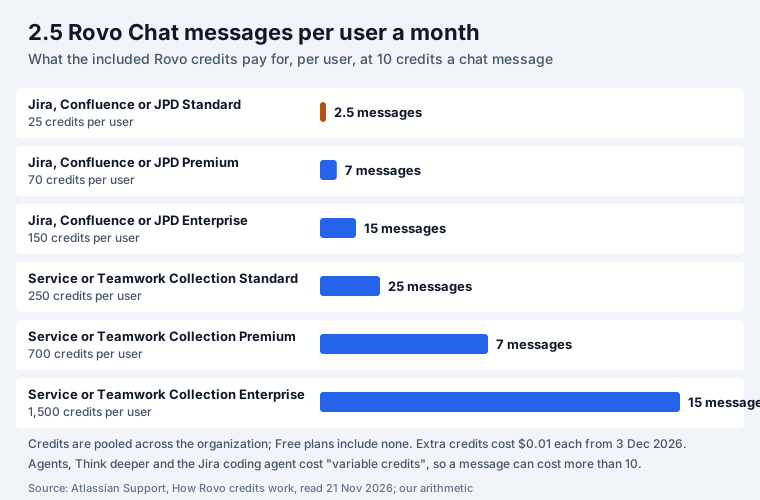
| Jira | 25 | 70 | 150 |
| Confluence | 25 | 70 | 150 |
| Service Collection | 250 | 700 | 1,500 |
| Teamwork Collection | 250 | 700 | 1,500 |
| Jira Product Discovery | 25 | 70 | 150 |
From How Rovo credits work: “the list price at this time is $0.01 per Rovo credit, or $10 per 1,000 credits”, and pay as you go is on by default. Rovo Chat quick answers cost “10 Rovo credits per billable event”, and “each user message is a billable event”. Agents, Think deeper and the Jira coding agent cost “variable credits”; enriched Teamwork Graph calls, the search tools of the Rovo MCP server among them, are mostly 1–10 credits each. The table has no row for Jira Service Management on its own, so the calculator gives it no credits.
The worked example
A 10-person team on Jira Standard has 4,000 steps and 250 Rovo credits a month. Its three rules: a comment when work reaches Done, triggered by all 400 status changes with the Done check after the trigger, so 150 runs act at 3 steps (450, or 300 with the check inside the trigger); closing the open sub-tasks of 150 finished parents, 4 sub-tasks each, 3 of them open (9 steps a run, 1,350); and a Rovo triage note on the 60 bugs among 200 new work items (180 steps, 600 credits at 10 each). That is 1,980 of 4,000 automation steps, no extra cost. Twenty Rovo Chat messages per person add 2,000 credits: 2,600 Rovo credits against 250, 2,350 extra, $23.50 a month. For most small teams the steps are not the bill; Rovo is.
Five ways to spend fewer steps
- Put the status or JQL check inside the trigger when the trigger offers it: one step less on every run that acts. The last column of the table shows the saving.
- Look up, do not branch, when you only need a list: Lookup work items is free, a branch costs a step per item.
- Filter before the branch. A branch over every sub-task runs its condition on each; JQL in the branch skips the ones you do not need.
- Narrow the scope. A rule that never acts in a space costs nothing there now, but one that acts by mistake costs every step it runs.
- Read Usage after a week: Jira Settings, System, Global automation, Usage lists the flows that use the most.
Reminders and Done gates without automation steps
Two common jobs need no automation at all. Deadline Tracker sends its daily due-date reminder from the app itself, a Forge scheduled job, so it uses none of your steps, and shows what is overdue, due today and this week on one board. Team Checklist blocks a transition to Done until every checklist item is done with a workflow validator, not a rule. Both are free for up to 10 users.
Frequently asked questions
What counts as an automation step?
Every trigger, condition, action, branch and loop iteration that runs. A condition set inside the trigger is part of the trigger’s step. Log action, Create variable, Create lookup table, Re-fetch work item data and Lookup work items are free, and since 5 November 2026 a run that performs no action costs nothing.
How much do extra automation steps cost?
$0.50 per 1,000 steps over the pooled allowance, billed from 3 December 2026. If pay as you go is off, flows stop at 100 % until the allowance resets; admins can also set a monthly limit.
How many Rovo credits do I get per month?
25 per user on Jira, Confluence or Jira Product Discovery Standard, 70 on Premium, 150 on Enterprise; 250, 700 and 1,500 per user on Service and Teamwork Collection. They are pooled across the organization and do not roll over. Free plans include none.
What consumes Rovo credits?
Rovo Chat costs 10 credits per message at the basic tier; agents, Think deeper, the Jira coding agent and Use Rovo in automation cost variable credits; enriched Teamwork Graph calls, such as Rovo search through MCP, mostly 1 to 10 credits. Rovo Search in the apps, summaries and definitions are free.
How much do Rovo credits cost?
Atlassian’s list price is $0.01 per credit, $10 per 1,000, for use beyond the included allowance from 3 December 2026. Pay as you go is on by default.
How do I check my real usage?
In Jira: Settings, System, Global automation, Usage, and each flow’s audit log shows its steps per run. Organization admins: Atlassian Administration, Usage, for both automation steps and Rovo credits, with a CSV export.
Is my data sent anywhere?
No. The calculator runs in your browser; nothing you type is sent, logged or stored.
Sources
- Atlassian Support, How is my usage calculated (automation steps), read 21 November 2026.
- Atlassian Support, How Rovo credits work, read 21 November 2026.
- Our test flows on a Jira Cloud site, 5 November 2026: Jira automation examples. All of Jira’s limits in one place: Jira limits 2026.