FREE TOOL · INCIDENTS
MTTR calculator
Paste the incidents of a month or a quarter. Get mean time to recovery, mean time to acknowledge, mean time between failures and the availability they add up to, next to the usual targets.
Results
- MTTR (recovery)
- 45 min
- MTTA
- 9 min
- MTBF
- 9 d 23 h 15 min
- Availability
- 99.688 %
3 incidents, 2 h 15 min down in total, longest 1 h 15 min; MTTA from 2 acknowledged.
| Target | Allowed downtime | Your downtime fits? |
|---|---|---|
| 99 % | 7 h 12 min | Yes |
| 99.5 % | 3 h 36 min | Yes |
| 99.9 % | 43 min 12 s | No, over by 1 h 31 min |
| 99.95 % | 21 min 36 s | No, over by 1 h 53 min |
| 99.99 % | 4 min 19 s | No, over by 2 h 10 min |
Which MTTR?
Before comparing numbers, agree on the letter R. Atlassian's incident guide puts it plainly: “The R can stand for repair, recovery, respond, or resolve, and while the four metrics do overlap, they each have their own meaning and nuance.” On one outage they give four different numbers:
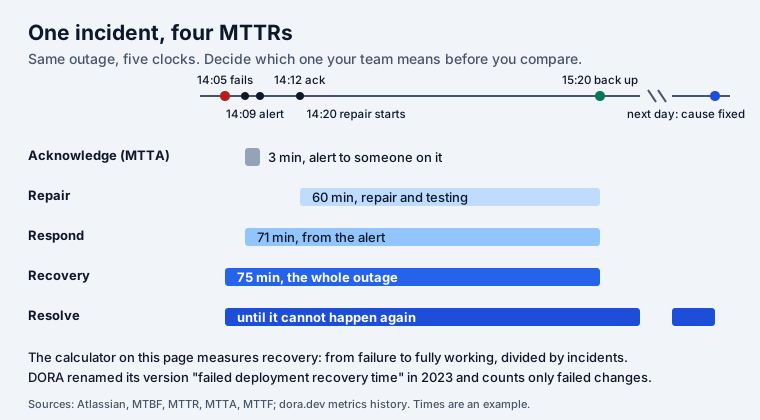
This calculator measures recovery: from the moment the service fails to the moment it fully works again. Atlassian's formula is “MTTR = Total downtime ÷ Number of incidents”. If your start time is the alert rather than the failure, you are measuring respond; keep it the same every month.
The formulas
- MTTR = total downtime ÷ number of incidents.
- MTTA = time from start to acknowledgement, averaged over the incidents that have one.
- MTBF = total operational time ÷ number of failures, where operational time is the period minus the downtime.
- Availability = MTBF ÷ (MTBF + MTTR), which works out to uptime ÷ the whole period.
All four come from Atlassian's guide MTBF, MTTR, MTTA, MTTF. One difference: Atlassian defines MTTA from the moment of the alert. Paste the alert time as the start if that is the number you want.
A worked example
The three incidents in the box above lasted 75, 25 and 35 minutes in November 2026: 135 minutes in all, so MTTR is 135 ÷ 3 = 45 minutes. Two of them were acknowledged, after 7 and 11 minutes: MTTA 9 minutes. November has 43,200 minutes, so MTBF is (43,200 − 135) ÷ 3, about 9 days 23 hours, and availability is 99.688 %. That meets 99.5 % and misses 99.9 %, which allows 43 minutes 12 seconds a month.
MTTR and DORA
DORA's research used “mean time to recover” as one of its first four delivery metrics. In 2023 it was “renamed and redefined as failed deployment recovery time”, according to DORA's history of its metrics, because the old definition did not separate failures caused by a change from those with outside causes, such as a data center outage. If you report DORA numbers, count only incidents that a deployment caused.
Want to see what a target means for trust over a year? The SLA uptime calculator shows the downtime each number of nines allows, and the error budget calculator turns a target into a budget and burn rates.
Incidents in Jira Service Management?
SLA Reports builds weekly and monthly reports from JSM's own SLA fields: compliance per SLA, request type and priority, every breach and what is close to breaching, with the change from the previous period.
Frequently asked questions
How do you calculate MTTR?
Add up the downtime of every incident in a period and divide by the number of incidents. Three outages of 75, 25 and 35 minutes are 135 minutes; 135 / 3 = 45 minutes MTTR. That is mean time to recovery, the most common meaning.
What does the R in MTTR stand for?
Four things, Atlassian’s incident guide says: repair, recovery, respond or resolve. Recovery runs from failure to fully working; respond from the alert; repair from when work starts; resolve until the cause is fixed. Agree on one before you compare numbers.
What is the difference between MTTR and MTBF?
MTTR is how long an incident lasts on average; MTBF is how long the service runs between incidents: operational time divided by the number of failures. Together they give availability: MTBF / (MTBF + MTTR).
What is a good MTTR?
It depends on what the service promises. Work backwards from the target: at 99.9 % over 30 days you may be down 43 minutes 12 seconds in total, so three incidents a month must average under about 14 minutes. The table under the calculator does this for your period.
Is MTTR still a DORA metric?
Not under that name. DORA renamed it failed deployment recovery time in 2023, counting only failures caused by a change to production, because the old definition mixed in outages with external causes, such as a data center going down.
Is my incident data sent anywhere?
No. The numbers are worked out in your browser; nothing is sent, logged or stored.