Sick Leave vs. Vacation Leave: Should You Track Them Separately?
The behavior a combined policy accidentally creates
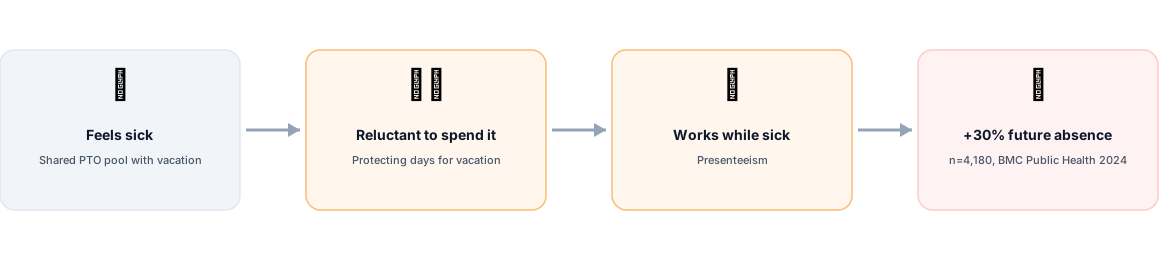
Merging sick days into the same pool as vacation — a single “PTO bank” rather than two separate categories — is a common simplification, and it has a real, documented side effect worth understanding before adopting it: employees become reluctant to spend a shared pool of days on being sick, specifically because every sick day taken is a vacation day not taken later. Organizations that have made this switch report exactly this outcome in practice — people coming to work sick instead of using PTO, precisely to preserve it for planned time off.
What the research says about the consequence of that choice
This isn’t just an intuition — a 2024 peer-reviewed study using the Korean Health Panel Study (4,180 wage workers aged 20+, published in BMC Public Health) found that employees who worked while sick had roughly a 30% higher likelihood of later absenteeism (odds ratio 1.30) than employees who didn’t report working while ill. The study’s own framing is direct: presenteeism is a reliable predictor of more time off later, not less — showing up sick doesn’t actually save time off overall, it defers and likely compounds it.
The case for separating them, and the case against
For separating sick and vacation leave: it removes the specific incentive structure the research above documents — a sick day doesn’t compete with a vacation day for the same limited pool, so there’s no rational reason to defer rest to protect planned time off. This matters most for organizations with real, visible presenteeism patterns already, or any workplace where close physical proximity makes the contagion cost of working sick concrete rather than abstract.
For a single combined pool: genuinely simpler to administer, and some organizations deliberately want employees to have full autonomy over how they use their total time off without a category boundary dictating it. This is a legitimate policy choice, not a mistake — as long as it’s made deliberately, with the presenteeism risk understood, rather than adopted by default because “PTO” sounded simpler than maintaining two numbers.
An honest limitation in OutSync today
OutSync records a leave type — vacation, sick, or other — as a label on every request, and that label is visible in the approval queue and audit log for reporting purposes. What it doesn’t currently do is maintain separate, independently-accruing balances per type: a sick day and a vacation day draw from the same shared annual balance, distinguished only by label, not by a separate pool. For an organization whose policy specifically requires sick leave to accrue and deduct independently from vacation — precisely the structure that avoids the presenteeism incentive described above — this is a real, current gap worth knowing before assuming the type field implies separate accounting. It doesn’t, today.
Related reading
Frequently asked questions
Does combining sick and vacation leave into one PTO bank actually change behavior?
Documented cases of organizations switching to a combined PTO bank report exactly this unintended consequence: employees become reluctant to spend shared PTO on illness and come to work sick instead, specifically to preserve days they'd rather use for planned time off.
What does the research say about working while sick?
A 2024 study using the Korean Health Panel Study (4,180 wage workers, published in BMC Public Health) found employees who worked while sick had roughly a 30% higher likelihood (odds ratio 1.30) of later absenteeism than those who didn't — presenteeism predicting more time off later, not less.
Does OutSync track sick and vacation leave as separate balances?
Not currently — OutSync records a leave type (vacation, sick, or other) as a label on each request for visibility and reporting, but deducts from one shared annual balance regardless of type. This is an honest, current limitation for any organization whose policy specifically requires separate, independently-accruing sick and vacation pools.