How Many Vacation Days Is Normal? PTO Benchmarks by Industry
A question with a real, tracked answer
“How many vacation days should we offer?” doesn’t have to be a guess — the U.S. Bureau of Labor Statistics tracks this exact question annually through its Employee Benefits Survey, and the tracked answer is more nuanced than a single number.
What the benchmark data actually shows
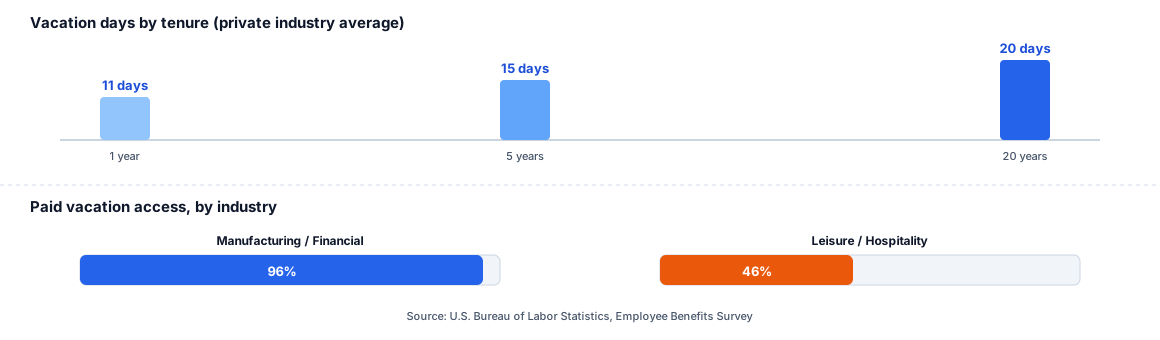
Access isn’t universal, and varies enormously by industry. Roughly 76% of private-industry workers overall have access to paid vacation time — but that headline number hides a large spread: 96% of manufacturing and financial-activities workers have access, compared to just 46% of leisure and hospitality workers. For a large share of one industry’s workforce, “how many days” isn’t the relevant question at all — access itself is the gap.
Days offered scale with tenure, not a flat number. Among workers who do have access, BLS data shows an accrual-by-tenure pattern: roughly 11 days after 1 year of service, 15 days after 5 years, and around 20 days after 20 years. A policy that offers every employee the same flat number regardless of tenure is actually the less common approach among employers tracked by this survey — most policies scale up over time.
Why this matters more than picking a round number
Setting a policy at “15 days for everyone” without checking which of these benchmarks actually applies risks two different mistakes in opposite directions: offering less than the norm in a high-access industry (a real recruiting disadvantage against competitors who track and match the benchmark), or offering a flat policy that ignores the tenure-scaling structure most comparable employers actually use, which can read as less competitive to a long-tenured candidate even if the year-one number looks fine.
The honest, useful version of this benchmark isn’t “here’s the number to copy” — it’s “here’s what to check before setting the number,” specifically:
- What’s the norm in your actual industry, not the private-sector average across every industry combined.
- Does your policy scale with tenure, matching how most comparable employers structure theirs, or is it flat?
- Is access itself the gap for your industry, separate from the number of days offered to those who already have it?
An honest limitation, stated plainly
OutSync’s accrual policy today is a single org-wide default — days per year, half-day increments, and a carryover cap — rather than a schedule that automatically increases as an individual employee’s tenure grows. An organization that wants to match the BLS tenure-scaling pattern precisely (11 days at year one, rising to 15 at year five) currently needs to update the org default manually as that milestone approaches, rather than have it apply automatically per employee. Worth stating this limitation directly rather than implying a capability that isn’t there yet — see the Standard vs. Advanced edition breakdown for exactly what today’s accrual policy does and doesn’t cover.
Related reading
Frequently asked questions
What's the average number of paid vacation days in the US?
Per the U.S. Bureau of Labor Statistics' Employee Benefits Survey, private-industry workers average around 11 paid vacation days after 1 year of service, rising to about 15 days after 5 years and roughly 20 days after 20 years — accrual by tenure is the norm, not a flat number that applies to every employee equally.
Does every industry offer the same vacation benefits?
No, and the gap is large. BLS data shows paid vacation access at 96% for manufacturing and financial-activities workers, compared to only 46% for leisure and hospitality workers — nearly half of that industry's workforce has no paid vacation benefit at all, a bigger factor than the number of days offered to those who do have access.
Does OutSync support tenure-based accrual that increases over time?
OutSync's accrual policy is currently a single org-wide default (days per year, half-day increments, carryover cap) rather than an automatically-increasing schedule keyed to each employee's tenure — a real, current limitation worth stating plainly rather than implying a capability that isn't there yet.