Agent Skills for Teams: 6 Ways to Share Them, Compared
On this page
Three teams in one company use Claude Code. Each wrote a code-review skill. One says “run the
linter first”, one says “never comment on style”, one is a copy of a public skill from last spring.
An agent that reviews a pull request touching all three repositories gets three answers to one
question.
That is not a hypothetical. In the 1,000 most-starred repositories on GitHub, a skill folder called
code-review appears in 23 of them. Skills are easy to write and hard to share. Here are the six ways a
team can share them, what each reaches, and what the top repositories do today.
Short answer: a team can share agent skills (1) in the repository, .claude/skills or
.agents/skills; (2) in a Claude Code plugin marketplace from a private repository; (3) through
managed settings on every company machine; (4) as organization skills on claude.ai, which Claude
Code syncs; (5) as a package people install; or (6) in a library in Jira that hands each work
item’s agent the skills of its project and roles. The first four are Claude-centred; the repository and
Jira routes reach Codex, Copilot and Cursor too. Whatever you choose, keep one copy per skill, an owner,
and no keys.
What the top repositories do today
We read the file trees of the 1,000 most-starred GitHub repositories on 18 November 2026.
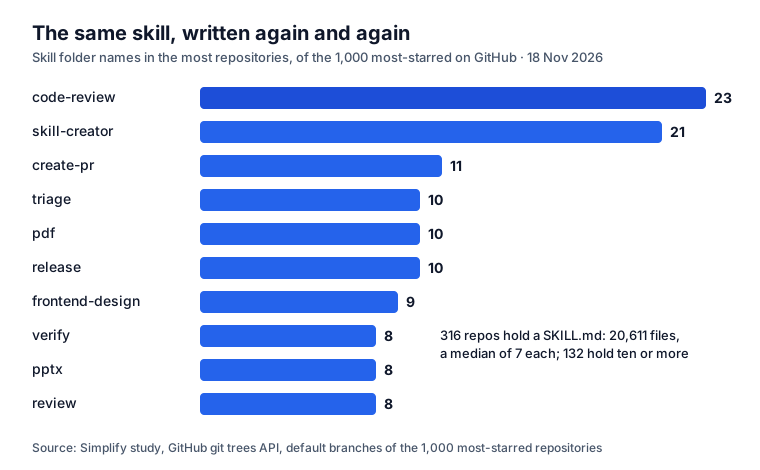
- 316 of 1,000 hold a file named
SKILL.md, 20,611 files in all. The median repository with skills has 7; 132 have ten or more. One skills collection alone has 9,634. - Skills sit in
.agents/skillsin 114 repositories,.claude/skillsin 81,.github/skillsin 18. - The same jobs come back under the same names:
code-review(23 repositories),create-pr(11),release(10),triage(10).skill-creator(21) is mostly Anthropic’s own, copied in. - In our separate sample of 1,904 public SKILL.md files, 97 were exact copies of another file in the sample. Copies do not get the fix when the original does.
Skills spread the way snippets do: copied, adapted, forgotten. The SKILL.md format study shows the result: 38% of public skills would fail a claude.ai upload, often because of fields someone copied in.
Six ways to share, side by side
| Way | Scope | Reaches | How it updates |
|---|---|---|---|
| 1. Commit to the repository | one repository | Claude Code, Copilot, Cursor (.claude/skills); Codex, Copilot, Cursor (.agents/skills) | a pull request |
| 2. Claude Code plugin marketplace | the teams that add it | Claude Code | a plugin version; people update |
| 3. Managed settings folder | every machine you deploy to | Claude Code | your device management |
| 4. claude.ai organization skills | the organization’s accounts | claude.ai, Cowork, Claude Code with a claude.ai sign-in | synced about every 10 minutes in active sessions |
| 5. A package (npm, a .zip) | whoever installs it | any agent, once copied into its folder | people reinstall |
| 6. A library in Jira (Agent Ready) | each project, role and work item | any agent that takes the work item | edit once; the next brief has it |
1. In the repository
The simplest and the most portable. Claude Code loads .claude/skills/<name>/SKILL.md for “Sessions in
this repository” and its docs say “Commit it so your team gets it too”. Codex reads .agents/skills
from the working folder up to the repository root. GitHub Copilot reads .github/skills,
.claude/skills and .agents/skills; Cursor reads .cursor/skills and .agents/skills, and also the
Claude and Codex folders. No single folder covers all four, so pick .agents/skills or .claude/skills
and link the other.
The limit is the boundary: a skill about how your company handles secrets belongs to every repository,
and copying it into each is how you get 23 code-review skills.
2. A Claude Code plugin marketplace
A plugin can carry skills, and a marketplace is a catalogue in a Git repository, which “can be private”.
Teammates run claude plugin marketplace add <owner>/<repo> and install plugins by name. Good for a
platform team that publishes skills to many repositories. It reaches Claude Code only.
3. Managed settings
Claude Code’s highest-priority skill location is “.claude/skills/<skill-name>/SKILL.md in the managed
settings directory”, for “All users on machines where your organization deploys it”. Enterprise skills
win over personal ones of the same name. Right for rules that must be the same everywhere; heavy for
skills that change weekly.
4. claude.ai organization skills
Skills enabled for a claude.ai account, including “skills your organization provides there”, load in Cowork and cloud sessions, and Claude Code in the terminal “syncs those skills in sessions where you sign in with your claude.ai account”, checking about every 10 minutes while you work. They do not sync for sessions on an API key or on Amazon Bedrock. Uploads accept only the spec’s six frontmatter fields.
5. A package
Zip the folder or publish it as an npm package, and people copy it into their agent’s folder. Easy to
start, hard to keep current: every install is a copy. Agent Ready can import the .tgz that
npm pack downloads, which is one way to turn a package into one shared copy.
6. A library in Jira, by project and role
The five ways above share skills by where the code is or who the person is. Work is organised differently: a mobile security change needs the security team’s skills whichever repository it touches; a database migration needs the migration skill whoever picks it up.
Agent Ready, our Jira app, keeps skills where the work is planned:
- a company library (Jira admins) and each project’s own skills (project admins), as a tree of categories with search; a project can turn off a company skill that does not fit;
- skills in every brief for a project, and skills per role (Security, Backend, QA, or your own, such as “Mobile security”) that come with every work item the role is on;
- per work item, someone who may edit it can add or remove a skill; JQL finds them with
agentSkill = "playwright-tests"; - import SKILL.md files, a .zip of a skills folder or an npm
.tgz, read in the browser with nothing fetched from the internet; Copy as SKILL.md or Download SKILL.md takes one back to a repository; - a skill with a password or key in it is not saved.
On our test site, MOBL-15 “Enable fingerprint identity to be used on mobile” has the role Mobile
security. Its For the agent tab says “5 skills go to the agent with the brief”: two from the
project (Secrets and keys, Changelog and release notes) and three from the role (Biometric sign-in,
Detox end-to-end tests, Feature flags for app releases). Each skill’s instructions join the agent’s
brief, which reaches the agent in three ways: Copy brief for the agent, a comment posted when the
work item is assigned to an agent (Copilot, Cursor and Claude read comments), and Agent Ready’s MCP
tools, where get-agent-brief returns the brief and get-skill one skill by name.
The trade-off is honest: these skills reach the agent as text in its brief, not as skills installed in Claude Code or Codex. That is what makes them work for every agent, and why the Copy as SKILL.md button exists for the skills you also want in a repository.
Security: a skill is code you did not write
Anthropic’s warning applies to every way above: “Use Skills only from trusted sources: those you created
yourself or obtained from Anthropic.” A skill can tell an agent to run a script, fetch a URL or call a
tool, and allowed-tools can pre-approve tools for the turn that runs it.
- Review skills like code: a pull request, a reviewer, an owner.
- Read every script a skill ships, not just SKILL.md.
- No keys in skills. A skill is shared and sent to the model. Our free SKILL.md validator fails a skill with a vendor key in it, for every target.
- Pin what you import. A copy you reviewed is safer than a link that changes.
A rollout plan for a team
- Inventory. List the skills people already have in
~/.claude/skillsand in repositories. Expect duplicates:code-review,release,create-pr. - Merge the duplicates into one skill per job, with an owner in
metadata. - Validate each against the spec, so it loads everywhere, not only in Claude Code.
- Pick the home by scope: repository skills in the repository, company and practice skills in one shared place (a plugin marketplace for Claude Code shops, a Jira library for mixed agents).
- Measure. Ask in each retro which skill was used and which was wrong. Retire the ones nobody uses.
Sources
- Claude Code: Extend Claude with skills (locations, enterprise skills, synced claude.ai skills) and plugin marketplaces, read 18 November 2026.
- OpenAI: Codex skills. GitHub: About agent skills. Cursor: Skills.
- Anthropic: Agent Skills overview, security considerations.
- Agent Ready: user guide, Agent skills.
- Our data: default-branch trees of the 1,000 most-starred GitHub repositories, 18 November 2026; 1,904 public SKILL.md files from GitHub code search, same day.
Frequently asked questions
How do I share a Claude skill with my team?
For one repository, commit it to .claude/skills/<name>/SKILL.md. For many repositories, put it in a plugin in a private Claude Code plugin marketplace and have teammates run claude plugin marketplace add <owner>/<repo>. For every machine in a company, deploy it to the managed settings folder, or provide it as an organization skill on claude.ai, which Claude Code syncs for people signed in with claude.ai.
Can the same skill work in Claude Code, Codex, Copilot and Cursor?
Yes, if its frontmatter sticks to the six fields of the Agent Skills spec. The folders differ: .claude/skills is read by Claude Code, Copilot and Cursor; .agents/skills by Codex, Copilot and Cursor. Keep one copy and link or copy it into the other folder, and check it with a SKILL.md validator.
Who should own a team's skills?
The people who own the practice the skill describes: the security lead for "secrets and keys", the mobile team for "biometric sign-in". Put the owner in metadata, review changes like code, and retire skills nobody owns. A skill nobody maintains becomes a confident, outdated instruction.
Are skills from public repositories safe for a team?
Only after review. Anthropic says to use skills "only from trusted sources", because a skill can tell an agent to run code or call tools. Read the SKILL.md and every script it ships, check what allowed-tools pre-approves, and keep keys out of skills entirely.