Unlimited PTO: Pros, Cons, and What the Data Actually Shows
A story that flipped, and mostly didn’t get corrected
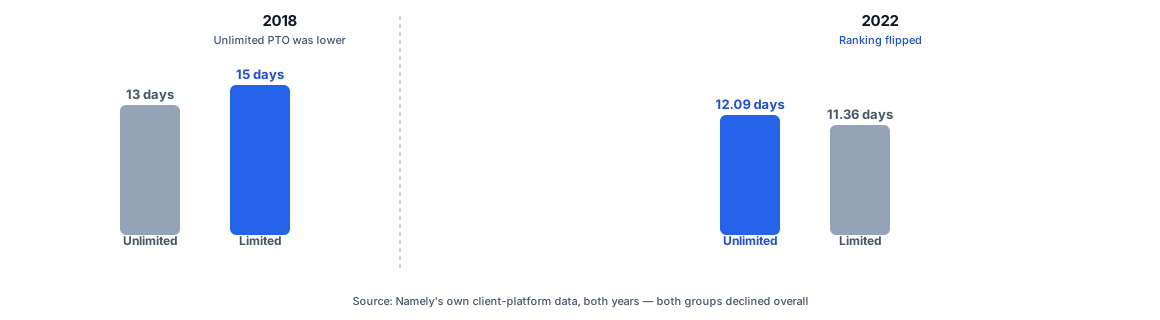
“Unlimited PTO means people take less vacation, not more” is one of the most repeated claims in HR content — usually traced back to a 2018 finding from Namely, an HR platform, based on its own aggregated client data: employees on unlimited plans took 13 days a year on average, compared to 15 days for employees on traditional, capped plans. The counter- intuitive finding made for a good headline and got cited constantly.
What gets repeated much less often: Namely’s own later update, using 2022 data across roughly 1,000 companies on its platform, found the opposite. Unlimited-PTO employees averaged 12.09 days, edging out limited-plan employees at 11.36 days — the ranking flipped. Both groups took fewer days than in 2018 (a real, separate trend worth its own attention), but the specific claim “unlimited PTO makes people take less” no longer holds, at least in this same company’s own more recent numbers.
Why the original effect existed at all
The mechanism behind the 2018 finding is worth understanding even though the ranking has since flipped, because it explains a real, ongoing risk with unlimited policies specifically. A defined number — “15 days a year” — functions as a shared social reference: everyone in the company knows roughly what’s considered normal to take. Remove the cap, and that shared reference disappears. Each employee is left to privately decide what looks acceptable, without the anchor a fixed number provided — and the consistent finding across this research is that people set that bar for themselves lower, not higher, out of a reasonable fear of looking less committed than peers who are also quietly under-taking their own time off.
That mechanism hasn’t gone away just because the 2022 numbers flipped — it’s a real risk any unlimited policy still carries, worth actively managing rather than assuming solved because one dataset’s average moved.
The real pros and cons, stated plainly
Pro: no accrual administration. Nothing to calculate, no carryover cap to configure, no balance that can run out mid-year. For a company that wants to remove PTO math entirely, this is a genuine simplification.
Pro: strong signaling value. Regardless of whether people actually take more days, unlimited PTO reads to candidates and employees as a trust signal — the 62% healthy-work-life- balance figure some surveys report for unlimited-PTO employees (versus 53% for traditional plans) likely reflects this perception more than the raw days-taken number.
Con: the missing-anchor problem doesn’t go away. Every individual manager, not a company- wide policy number, becomes the de facto norm-setter for their own team — inconsistent across an organization by construction, and dependent on that manager actively modeling and encouraging real time off rather than assuming the policy handles itself.
Con: nothing forces visibility. An unlimited policy removes the accounting problem, but it doesn’t remove the need to actually see who’s taking time and who isn’t. If anything, the absence of a shared numeric benchmark makes active, visible tracking of actual usage more important, not less — a manager can’t rely on “everyone gets 15 days” as a baseline expectation anymore.
What this means for tracking, regardless of which policy a company picks
OutSync’s accrual policy supports an effectively unlimited setup — set days-per-year generously high, and the request/approval/balance workflow runs exactly the same as a capped policy. What doesn’t change with an unlimited policy is the value of the board-level “who’s out” visibility the ghost-resource piece covers — if anything, removing a shared numeric anchor makes it more valuable to actually see usage patterns directly, rather than assuming a policy without a cap is a policy without a problem.
Related reading
Frequently asked questions
Do employees with unlimited PTO really take less time off?
That was Namely's own 2018 finding (13 days for unlimited vs. 15 for limited plans), and it's the version of this story that still gets repeated most often. Namely's own 2022 update, based on roughly 1,000 companies' real platform data, found the opposite: unlimited-PTO employees averaged 12.09 days versus 11.36 for limited-plan employees — both groups took less overall, but unlimited had edged ahead.
Why would removing a cap make people take less vacation in the first place?
A defined number of days functions as a social permission slip — everyone knows 15 days is normal to take. Remove the cap and that shared reference disappears; each employee has to independently decide what looks acceptable, and the research consistently finds people set that bar for themselves lower than what was previously the norm, not higher.
Does OutSync work with an unlimited PTO policy?
Yes — set days-per-year generously high (or effectively uncapped) in the accrual policy and the rest of the workflow (requests, approval, "who's out" visibility) works identically. The one thing an unlimited policy doesn't remove is the need to actually see who's taking time and who isn't — if anything, that visibility matters more without a shared numeric anchor.