The Real Cost of "Who's Out?" Slack Messages
The question that seems too small to matter
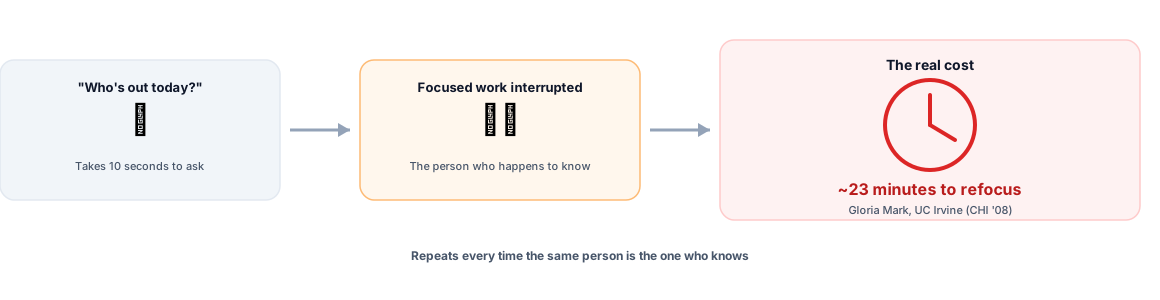
“Does anyone know if Priya’s out today?” reads like nothing — ten seconds to type, ten seconds to answer. It’s asked constantly precisely because it feels free. It isn’t, and the research on interruption cost is specific about exactly why not.
What interruption actually costs, according to the research
Gloria Mark’s study at UC Irvine — one of the most cited pieces of research on this topic, presented at CHI (the ACM Conference on Human Factors in Computing Systems) — tracked real office workers by direct observation across their full working days, recording every interruption and what happened afterward. The finding that gets quoted for good reason: it took an average of 23 minutes and 15 seconds to return to the original task at the same level of focus after being pulled away from it. Interrupted work in the same research was also measured, using a validated workload assessment (the NASA Task Load Index), as more stressful than uninterrupted work — not just slower, genuinely more taxing to do.
That’s the cost of one interruption, for the person being asked. A “who’s out” question isn’t usually asked once. It’s asked every time someone needs to know, to whoever happens to be reachable and likely to know — which brings the second, less obvious cost into view.
Where the cost concentrates
Availability information that lives in someone’s head, rather than somewhere anyone can check, routes every “who’s out” question to that specific person — usually a manager, a team lead, or whoever’s simply been around long enough to keep informal track. That’s not evenly distributed interruption cost; it’s concentrated on one or two people, repeatedly, every time the question comes up. Broader workplace research on tool fragmentation backs up how much of this kind of “work about work” adds up in aggregate — Asana’s Anatomy of Work index, surveying 9,615 knowledge workers, found the average worker touches 10 different apps a day just to get through routine coordination, and a “who’s out” question routed to a specific person rather than looked up directly is exactly that kind of avoidable coordination tax.
If a team already uses workload or stress monitoring — tracking deadline pressure, SLA compliance, or capacity signals inside Jira — this specific pattern (one person absorbing a steady stream of interruption for information that could have been self-serve) is precisely the kind of recurring load such a tool is built to surface. It’s a real, honest connection worth naming even though it’s a different product’s territory: reducing the interruption at the source is a smaller, more direct fix than measuring its downstream effect on that person’s stress metrics after the fact.
Making the question unnecessary
The actual fix isn’t “answer the question faster” — it’s making the question unnecessary by letting anyone check availability themselves, without interrupting anyone. OutSync’s “who’s out” board action on Jira and Team Availability tab on Confluence exist specifically for this: a self-serve lookup, in the same tool everyone’s already working in, with a Today / Next 2 weeks / Next month window covering the actual range someone usually needs an answer for. The information moves from one person’s memory to a screen — the same underlying shift the ghost-resource piece describes for planning decisions, applied here to the much more common, much smaller, and much more frequently repeated interruption of just asking.
Related reading
Frequently asked questions
Is a quick Slack question really that costly?
The message itself takes seconds. The cost is on the receiving end: Gloria Mark's widely-cited 2008 study (UC Irvine, presented at CHI) found that after being interrupted, workers took an average of 23 minutes and 15 seconds to return to their original task at the same level of focus — and that interrupted work was measured as more stressful, not just slower, using a validated workload assessment.
Who actually pays the cost of a 'who's out' question?
Usually not the person asking — it's whoever gets interrupted to answer it, often the same one or two people repeatedly (a manager, a team lead, whoever happens to keep informal track). That concentration is exactly the kind of recurring, avoidable workload spike a stress/workload-monitoring tool would flag if it were visible in the data at all.
How does OutSync reduce this specific interruption?
By making "who's out" a self-serve lookup — a board action on Jira, a Team Availability tab on Confluence — instead of a question that has to be routed to a specific person who happens to know. The information moves from someone's head to a screen anyone can check without interrupting anyone.