Why HR Leave Trackers Don't Help Sprint Planning
Two systems, two design centers
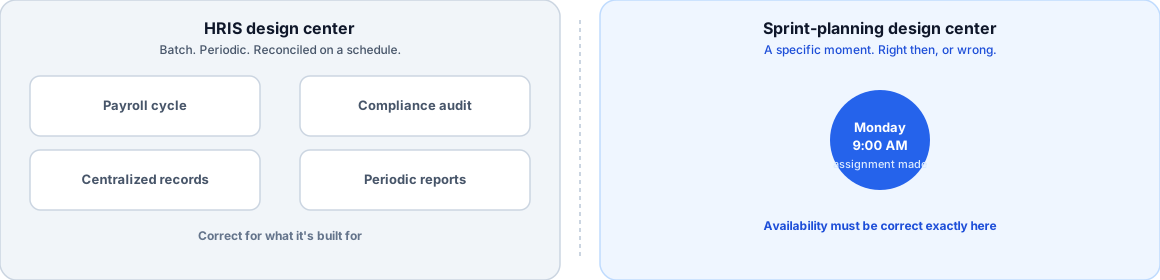
An HRIS — a human resources information system — has a well-established, well-documented purpose. ADP’s own definition puts it plainly: software “designed to help businesses meet core HR needs,” built around payroll (automatically deducting taxes and benefits from wages), compliance (staying current with tax law and employment regulation changes), centralized records, and periodic reporting — “proactively push[ing] reports, alerts or actions to stakeholders” on a cadence, not a continuous one.
Every one of those functions is inherently batch and periodic: payroll runs on a cycle, compliance gets audited on a schedule, reports get generated and reviewed. None of it requires being current to the minute. That’s not a limitation — it’s the correct design for what an HRIS is for.
Sprint planning has the opposite requirement. An assignment decision happens in a specific moment, and it needs to be right at that moment, not eventually reconciled in next month’s report. A vacation that’s accurately recorded in an HR system but not visible at 9am Monday when the sprint gets planned has, for planning purposes, not been recorded at all.
Where this shows up in real reviews
This isn’t an abstract architecture argument — it’s visible directly in how real users describe the gap in existing Jira-embedded leave apps, each pulled from that app’s own current Marketplace reviews:
- Leave Tracker (2-star review): “doesn’t allow admins to input vacations/sick days for their team members.” An HR-first design assumes the person taking leave is the one who reports it, through their own account, on their own initiative — a fine assumption for a compliance record, a broken one the moment a team lead needs to record a known absence for someone who isn’t going to self-report it (a contractor without an account, someone who forgot, someone on a different system entirely).
- UpRaise Employee Garrison (2-star review): rounding leave to the nearest 0.5 day “makes zero sense.” Half-day and partial-day leave is exactly the kind of granularity that matters for scheduling a specific afternoon meeting or code review, and matters much less for a payroll cycle that’s going to round to whole days anyway.
- Vacation Manager for Jira (multiple reviews across 2021, e.g. “Will this plugin be available for Cloud version?”): a leave tracker whose own release cadence — Server/Data Center first, Cloud later — mirrors the periodic, non-urgent cadence HR software is built to run on. Sprint planning happens weekly or biweekly, every team, indefinitely; a tool built on a slower release rhythm reflects a slower design rhythm underneath it.
None of these are implementation bugs a patch release fixes. They’re downstream consequences of which system’s design center a Jira app inherited when it was built.
What “sprint-planning-first” actually changes
Building for the planning moment rather than the compliance record changes concrete design decisions, not just marketing language:
- Availability lives where the assignment gets made — a board action, a space tab — not a separate report pulled up before planning starts.
- Admins can log leave on someone else’s behalf, because the requirement isn’t “did the employee self-report,” it’s “is this absence visible when work gets assigned,” and those aren’t always the same person’s responsibility.
- Half-day and partial-day leave are first-class, because a scheduling decision genuinely cares whether someone’s out for a morning meeting, not just whether a day gets rounded up or down in a payroll total.
- Approval is fast and scoped to the team doing the planning, not routed through a centralized HR queue that reconciles on its own schedule.
This is the same underlying argument as the ghost-resource problem, from the data-model side rather than the tool-fragmentation side: even a leave tracker that is inside Jira can still be built on HR-cadence assumptions that don’t serve the planning moment it’s sitting next to.
Related reading
Frequently asked questions
Isn't any tool that records vacation days basically the same?
The data being stored can look similar — a date range, a name, a status. What differs is the design center: an HRIS is built around payroll cycles, compliance audits, and centralized reporting, all inherently batch and periodic. A sprint-planning tool needs the same information available the moment an assignment decision is being made, on the same screen, with no separate lookup step.
Do any of the existing Jira leave apps get this right?
Several are well-built for what they're built to do — this isn't a quality critique. The gap shows up specifically in reviews about admin-side flexibility (logging leave for someone else, partial-day granularity) — exactly the kind of friction that shows up when a tool's data model was designed around individual self-service HR requests rather than a team lead's real-time planning need.
Does OutSync replace an HRIS?
No, and it isn't trying to. OutSync doesn't do payroll, tax compliance, or benefits administration — it tracks leave requests, approvals, and balances specifically so that data is visible where sprint and space planning happens. An organization's real HRIS remains the system of record for compliance; OutSync is the system of record for "can I assign this person work this week."