OutSync vs. Teamployees: HR Hub or Sprint-Planning Tool?
The best-reviewed app in this category, honestly credited
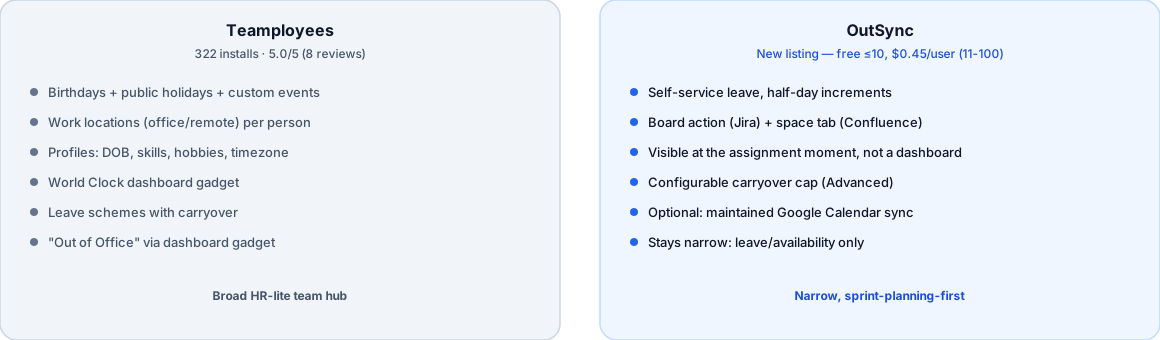
Teamployees carries a perfect 5.0/5 rating across 8 reviews and 322 installs, verified directly against Atlassian’s Marketplace API. That’s the strongest review record of any real competitor checked for this whole series, and it deserves to be said plainly before getting into where the two tools diverge: this is not a comparison built around finding a flaw. It’s about scope.
What Teamployees actually is
Its own Marketplace listing is explicit that leave tracking is one module in a broader teammate-information hub, not the whole product. The verbatim feature list includes:
- Request, approve, and manage leaves (vacations/sick days)
- Track birthdays & public holidays, plus custom events
- Leave schemes with allocated days and carryover
- Absence analytics/reporting, CSV-adjacent statistics
- Worklogs for Jira’s built-in time tracking
- Work Locations (Office/Remote) per person
- Teammate profiles — DOB, country, timezone, skills, hobbies
- A World Clock dashboard gadget for remote colleagues’ local time
- An “Out of Office” feature specifically aimed at preventing task assignment to unavailable teammates, plus an Events Overview dashboard gadget summarizing upcoming absences
That’s a genuinely broad HR-lite suite — closer to “team information hub with leave tracking built in” than “leave tracker with some extras.” Worth naming directly: it does attempt the same problem OutSync is built around — its “Out of Office” feature and Events Overview gadget exist specifically to stop tasks landing on someone who’s away. Crediting that correctly matters for an honest comparison.
Where the two tools actually diverge
Dashboard gadget vs. board action. A Jira dashboard is a page someone navigates to separately from the board where sprint planning happens. Teamployees’ Events Overview lives there. OutSync’s “who’s out” panel is a board action — opened from the same board’s own menu, in the same view an assignment decision gets made in. This is the exact distinction the ghost-resource piece argues matters: a dashboard someone could check before assigning work is not the same guarantee as availability data sitting in the view where the assignment itself happens.
Half-day increments. Teamployees’ listing doesn’t mention partial-day/half-day leave as a feature. OutSync’s accrual policy makes half-day increments an explicit, configurable setting — directly relevant for teams that regularly schedule half-days around meetings or appointments rather than only full-day absences.
Scope, by design. Teamployees’ birthday tracking, work-location field, world clock, and skills/hobbies profile fields are real, useful features for a team that wants a lightweight internal-directory layer on top of Jira. None of it is required to solve the specific problem of “does the sprint board know who’s out” — which is the entirety of what OutSync tries to do, deliberately, rather than growing into a broader team-info product.
Google Calendar. Neither app’s own listing describes syncing approved leave to a maintained Google Calendar automatically — Teamployees’ calendar view is internal to Jira. OutSync’s optional sync is additive on top of the board-level visibility both tools share the goal of.
Choose Teamployees when
- You want a lightweight internal team-directory layer (birthdays, locations, time zones, skills) alongside leave tracking, not leave tracking alone.
- A dashboard-level absence overview, checked as part of a planning routine, is enough visibility for how your team actually works.
- Carryover-based accrual schemes without half-day granularity match your policy as-is.
Choose OutSync when
- You want “who’s out” on the board itself, not a separate dashboard someone has to think to open before assigning work.
- Half-day increments are a real part of how leave gets requested and planned around.
- You’d rather the tool stay narrowly scoped to leave/availability than grow into a broader team-directory product.
Claim boundary
Both apps’ feature sets, ratings, and install counts change over time; the details above were verified directly against each app’s live Marketplace listing and reviews on the date this post was published. Re-check both listings directly before making a purchasing decision based on this page alone.
Related reading
Frequently asked questions
Does Teamployees try to solve the ghost-resource problem too?
Yes, and it's worth crediting that directly — its own listing describes an "Out of Office" feature meant to prevent assigning tasks to unavailable teammates, plus an Events Overview dashboard gadget summarizing upcoming absences. The distinction that still matters: a dashboard gadget is a separate page from the board where a sprint actually gets planned, while OutSync's "who's out" panel is a board action on the same screen the assignment happens on.
Does Teamployees support half-day leave or carryover?
Its own listing describes "leave schemes with allocated days and carryover," so carryover is covered. Half-day/partial-day increments specifically aren't mentioned in its feature list — OutSync's accrual policy makes half-day increments an explicit, first-class setting.
Which app has the better rating?
Teamployees, clearly — a perfect 5.0/5 across 8 reviews is a genuinely strong track record, and this comparison doesn't dispute that. The useful question for evaluating either isn't which has better reviews today; it's which one's actual scope matches what a specific team needs.