Checklist & Google Tasks Integration for Jira – Setup Guide
How to use Team Checklist — get started in 2 minutes, checklist templates, a team checklist on every Jira issue, your Google Tasks list, and the checklist in Jira search, boards, Automation and workflow rules.
Team Checklist puts a shared checklist on every Jira issue: the steps of done, ticked off by the team. Next to it, My Google Tasks keeps your own to-do list for the issue in Google Tasks.
How to read the pictures. Every screenshot comes from a real Jira site. The red boxes with numbers show where to look or click. Number 1 in the picture is step 1 in the text, number 2 is step 2, and so on.
Get started in 2 minutes
- Install Team Checklist from the Atlassian Marketplace (a Jira admin; free for up to 10 users) and approve the permissions — they are listed under What is stored, and where.
- Open any issue. Under the issue title, open the apps menu and choose Team Checklist. The panel appears in the issue, above the activity, on the Team checklist tab.
- Add your Definition of Done. Choose Templates next to Add, pick Definition of Done and press Add 5 items. Everyone who can see the issue now shares the checklist.
- Optional, for a Jira admin: make Jira refuse Done while items are open — see Block a transition until the team checklist is done.
Overview
Team Checklist adds a Checklist panel to every Jira issue. The panel holds two checklists, and always says which is which:
- Team checklist — shared by everyone who can see the issue and changed by everyone who may edit it. It is stored by Atlassian, in the app’s Forge storage — not in Google, and never on Simplify’s servers.
- My Google Tasks — your own Google task list for the issue. Every change is made in your Google Tasks, so the same tasks are on your phone, in Gmail and in Google Calendar. Only you see it.
Nothing personal becomes shared by itself: your Google tasks reach the team checklist only when you choose Share with the team… and confirm.
Install and open the panel
- Install the app from the Atlassian Marketplace and approve the requested permissions.
- Open any issue. Under the issue title, open the apps menu and choose Team Checklist. The panel appears in the issue, above the activity.
- Open an issue and click the apps button under its title.
- Choose Team Checklist. The panel appears in the issue.
The first time, a short note above the tabs explains what is shared and what stays private. Got it hides it.
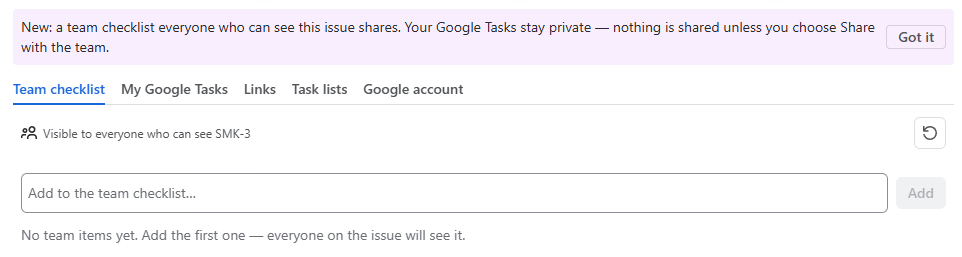
The panel has five tabs: Team checklist, My Google Tasks, Links, Task lists and Google account.
Team checklist
“Visible to everyone who can see” the issue — this is the checklist your team works on together.
- The Team checklist tab is the list your team shares.
- Everyone who can see the issue sees it.
- The bar shows the progress, here 2 of 4 done.
- Type an item into Add to the team checklist… and press Add or Enter.
- Click the box to tick an item off, or to reopen it.
- The badge shows who completed it.
- Add an item: type into Add to the team checklist… and press Add or Enter. Everyone on the issue sees it.
- Complete or reopen: click the circle in front of the item. The bar shows the progress, for example “2 of 6 done”.
- Who did it: each item says who added or completed it — “you”, or, from version 4, the person’s name from Jira (for example “Completed by Omar Diaz”; before that, “a teammate”).
- Edit: click the title or Add details to change them.
- Due date: Add due date opens a calendar.
- Click ⋯ on an item.
- Add details, a due date, a reminder in your Google Tasks, or a subitem.
- Move it up or down, or make it a subitem of the item above.
- Delete it.
The ⋯ button of an item has the rest:
- Copy to my Google Tasks — a personal copy in your Google Tasks (your “My Tasks” list), named with the issue key. When you complete the copy in Google, the team item is completed for everyone the next time you open the panel.
- Add subitem — one level of subitems, as in Google Tasks.
- Move up / Move down / Make a subitem of… / Move to the top level — reorder from the keyboard. With the mouse, drag an item to a new place.
- Delete… — asks in the row first: “Delete this item and its subitems for everyone?”
Who may change it. Jira’s permissions decide, checked on every change: people who can browse the issue see the team checklist; people who may edit the issue can change it. Everyone else sees the items read-only, with the reason. If a teammate changed an item a moment before you, the panel says so and shows the latest version.
From Google. In the Task lists tab, Copy to the team checklist… adds the open tasks of one of your Google lists to the team checklist.
Checklist templates
A template is a ready list of items your project reuses: a Definition of Done, acceptance criteria, the steps to verify a bug or ship a release.
- Click Templates.
- Pick a template.
- Check its items.
- Press Add 5 items (the number of items in it).
- Add a template: Templates next to Add (or type / and part of a template’s name in the add field, then Enter) lists the project’s templates. Pick one: the items already in the checklist are named (“Already in the checklist: …”) and are not added twice. Add N items adds the rest at the end — a template never replaces anything.
- Its own section: what a template added shows as a section with the template’s name and its own progress (for example 2/5). Undo next to “Added …” takes it away again.
- When the template changes: after a project admin edits a template, its sections in issues show Update available with the changes (+ added, − removed, old → new). Update applies them — done items stay done, the team’s own items are untouched; Not now hides the offer until the template changes again.
- Starter templates: a new project has four — Definition of Done, Acceptance criteria, Bug verification and Release checklist. They never add themselves.
Manage templates (project admins)
- Save this checklist as a template in the Templates list turns the issue’s checklist into a template.
- Project settings → Apps → Team Checklist templates lists the project’s templates as cards: create one (one item per line, ”- ” before a subitem), edit, rename, delete, and see how many work items use each and how many are on an older version.
- Added to new …: a template can add itself, once, to every new work item of a type (for example every new Story). Such a section says a project rule added it and has Remove section. It is off until an admin turns it on.
- Limits: 50 templates per project, 100 items per template, 500 items per checklist. Deleting a template keeps what it already added.
My Google Tasks
“Only you — kept in your Google Tasks.” Your personal checklist for the issue, stored in your own Google account.
Connect Google
The first time the panel needs Google, it asks you to connect your Google account (Forge, Atlassian’s app platform, shows the consent screen). Sign in with Google and allow:
- Create, edit, organize, and delete all your tasks —
https://www.googleapis.com/auth/tasks, the checklist itself; - See your primary email address and basic profile —
userinfo.emailandprofile, so the panel can show which Google account is connected.
The app asks for nothing else: it cannot read your mail, calendar or Drive. How this data is handled is described in the privacy policy.
Create or attach a list
An issue without a list says No checklist yet:
- Open My Google Tasks.
- Only you see this tab; the tasks live in your Google Tasks.
- Attach an existing list from your Google Tasks, or
- Create checklist: a new Google task list for this issue.
- Create checklist creates a Google task list named after the issue — “[SMK-3] - Launch the new checkout page” — and attaches it, in one click.
- Attach an existing list opens the Task lists tab, where you pick one of your lists.
Work with your tasks
The tab looks and works like the team checklist: the same rows with a drag handle, the subtasks chip (1/N), the ⋯ menu with Move up / Move down and Make a subtask of…, Delete with Undo, and Alt+arrow keys.
- Add a task, then complete it with the tick; a completed task stays in its place, ticked and struck through — tick it again to reopen it. Delete completed tasks… in the list’s ⋯ clears them in Google.
- Click a title or Add details to edit; Add due date sets a date (Google Tasks keeps the date and reminds you in Google Calendar and the Google Tasks apps).
- The ⋯ of a task: Attach a Drive link, Add subtask, Duplicate, Delete….
- Drag and drop to reorder, or drop a task onto another to make it a subtask.
- ↻ reads the list from Google again — changes you made in Google Tasks elsewhere appear.
- The list title can be renamed in place; its ⋯ has Remove or delete list… (remove it from the issue, or also delete it in Google Tasks).
- Share with the team… copies the list’s open tasks into the team checklist, after a question that says who will see them.
Attach a Drive link: in Google Drive choose Share → Copy link, paste the link and give it a name. It is added at the start of the task’s details as 📎 <name> (https://drive.google.com/open?id=…). The app does not upload files and does not read your Drive.
Links
A list of links kept with the issue (in Jira, not in Google), visible to everyone who opens the panel on the issue.
Enter a Title and a Link (web addresses only) and press Add link. The trash icon removes one link; Remove all links… removes all of them.
Task lists
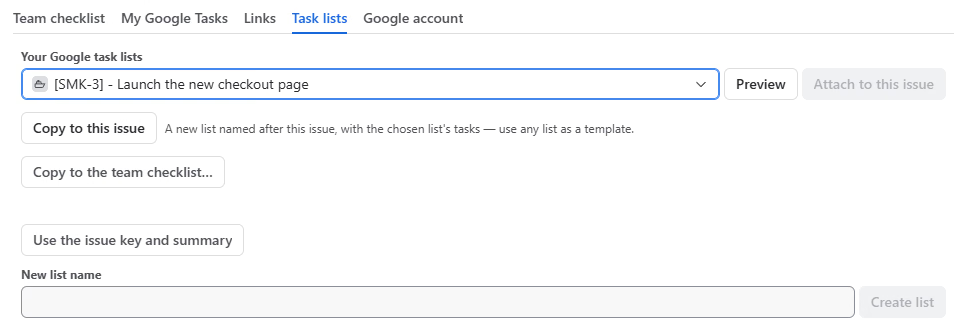
- Your Google task lists — pick one of your lists, then Preview it in a large dialog or Attach to this issue.
- Copy to this issue — use a list as a template: a new list named after the issue, with the template’s tasks and subtasks, becomes this issue’s checklist. The template is not changed.
- Copy to the team checklist… — the list’s open tasks become team items.
- New list name + Create list — a new list in your Google Tasks; Use the issue key and summary fills in the name.
Google account
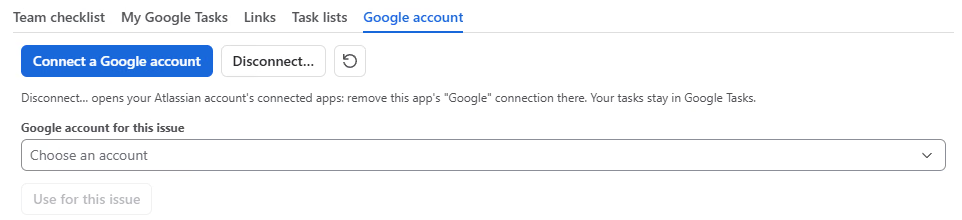
- Connect a Google account — connect another Google account.
- Google account for this issue + Use for this issue — which of your accounts this issue uses (per person and per issue).
- Disconnect… — opens your Atlassian account’s connected apps, where you remove this app’s “Google” connection. You can also remove the app’s access in your Google Account (Security → Third-party access).
Recipes (Jira admins)
Jira settings → Apps → Team Checklist opens the recipes — ready texts with Copy buttons:
- Board card colours, in the order to add them under the board’s ⋯ → Board settings → Card colors → Query (company-managed boards; the first match wins): green
teamChecklistComplete = "true", redteamChecklistOpen > 0 AND teamChecklistDue < now(), orangeteamChecklistOpen > 0. - Automation rules: a comment with the checklist’s progress on every transition; move to Done when the checklist is complete; a daily email to the assignee when open items are past due.
The app does not create the rules itself (Forge apps cannot create Automation rules): the admin adds them in Jira settings → System → Automation.
Find issues by their checklist (Jira search, boards, Automation)
From version 4, every change to the team checklist is copied into the issue as a Jira issue property (simplify-team-checklist), so Jira can search it. Nothing needs to be set up: these fields work in Filters → Search work items (JQL) for every user.
| JQL field | What it holds | Example |
|---|---|---|
teamChecklistDone | items done | teamChecklistDone > 0 |
teamChecklistTotal | all items, subitems included | teamChecklistTotal > 0 — has a checklist |
teamChecklistOpen | items not done | teamChecklistOpen > 0 AND status = Done |
teamChecklistPercent | done in whole percent, rounded down (0 for an empty one) | teamChecklistPercent < 50 |
teamChecklistComplete | "true" when there are items and all are done | teamChecklistComplete = "true" |
teamChecklistItem | the items’ titles (word search) | teamChecklistItem ~ "security" |
teamChecklistDue | the dates of the items not done | teamChecklistDue < now() — overdue items |
true and false are reserved words in JQL, so put them in quotes. An issue whose team checklist was last changed before version 4 appears in these searches after someone who may edit it opens the panel once.
Boards. Jira does not let apps draw on board cards, but a board admin can use the fields above on a company-managed board: Board settings → Card colors → Queries (for example teamChecklistOpen > 0 in amber and teamChecklistComplete = "true" in green), Quick filters (“Checklist not done”: teamChecklistOpen > 0) and Swimlanes → Queries.
Automation. Rules can use the JQL above in a condition (“Work item matches JQL teamChecklistComplete = "true"” → transition to Done) and read the values as smart values: {{issue.properties."simplify-team-checklist".done}} of {{issue.properties."simplify-team-checklist".total}}. The property is a copy for reading: a rule that changes it changes nothing in the team checklist.
Block a transition until the team checklist is done
From version 4, a Jira admin can keep an issue from moving to, say, Done while its team checklist has open items. It is off until an admin adds it to a transition.
Step 1: Add the rule to a transition
Open the workflow (Project settings → Workflows → Edit workflow), select the transition — for example the one into Done — and under Rules choose + next to Validate details. The rule Team checklist is done is listed among the rules (and under Marketplace rules, with the app’s name).
The rule needs no configuration — choose Add, then Update workflow.
Step 2: What people see
Moving an issue through that transition works only when its team checklist is complete. Otherwise Jira refuses the move and says: “Finish the team checklist first: every item must be done (the Checklist panel shows what is left).” Issues without a team checklist pass.
The rule is offered in company-managed workflows, and in team-managed ones where Jira lets apps add rules. It reads the copy of the checklist kept in the issue, so it is a workflow guard, not a lock: someone who may edit the issue could change that copy through Jira’s REST API.
What is stored, and where
- Permissions the app asks for: read Jira work (the issue it runs on), app storage (the team checklist and templates), write issue properties (the searchable copy below) and read Jira users (who completed an item). It cannot change issue fields, comments or workflows.
- In Atlassian (the app’s Forge storage): the project’s checklist templates; which Google task list is attached to an issue; each person’s choice of Google account per issue; the Links tab’s links; the team checklist (titles, details, dates, done or not, and who added, completed and last changed each item, as Atlassian account ids); which team items you copied to your Google Tasks.
- In the issue (Jira, from version 4): the copy of the team checklist for search, Automation and workflow rules — progress, open items’ dates, item titles; no details, names or account ids.
- In your Google Tasks: your lists and tasks, which you see and control in Google.
- On Simplify’s servers: nothing — the app has no server of its own.
Details: privacy policy.
Troubleshooting
- “The task list could not be found in Google Tasks” — the attached list was deleted in Google, or it is in someone else’s Google account. Google task lists cannot be shared: for a checklist the whole team sees, use the Team checklist.
- “Your Google access has expired or was removed” — reconnect in the Google account tab.
- “Google Tasks is busy right now” / “not answering right now” — Google refused for a moment and the app already retried; try again in a minute.
- “You can view this team checklist; changing it needs permission to edit the issue.” — ask a Jira admin for the Edit issues permission in the project.
- “Team Checklist needs an active licence” — ask a Jira admin to renew the app in Manage apps.
Questions? Contact us through our Support Desk.