Kanban Status Board for Jira – User Guide and Setup
How to use Kanban Status Board for Jira: real workflow transitions by drag and drop, WIP limits, WIP aging, throughput, swimlanes, column sums and saved views.
Kanban Status Board shows a project’s issues as cards in columns, one column per status. Drag a card to the next column to move it through your workflow, keep work in progress within limits, and see how long cards wait.
How to read the pictures. Every screenshot comes from a real Jira site. The red boxes with numbers show where to look or click. Number 1 in the picture is step 1 in the text, number 2 is step 2, and so on.
Get started in 2 minutes
- Install Kanban Status Board from the Atlassian Marketplace (a Jira admin; free for up to 10 users).
- Open it: a project’s sidebar → Kanban Status Board.
- Drag a card to the next status — the real workflow transition runs. Set WIP limits in View settings and Save changes.
- Save changes keeps the board as your saved view; Filters → Projects or Groups widens it to the whole team.
Overview
Kanban Status Board shows a Jira project’s issues on a Kanban board with one column per status of each issue type’s workflow — a separate board for each issue type (“Story Issues”, “Bug Issues”…). Dropping a card on another column runs the real workflow transition into that status.
Every change is made as you, with your own Jira permissions and your workflow’s rules: if Jira would refuse it, the app does too — the card goes back and a message gives Jira’s reason. The app runs on Atlassian Forge and stores only your saved filters and views, in your Atlassian site.
Install and open the board
- Install Kanban Status Board from the Atlassian Marketplace (a Jira admin approves the permissions).
- Open a project. Kanban Status Board is in the project’s navigation (under More when the row is full).

- Open a project and click Kanban Status Board in its navigation (under More when the row is full).
The board shows that project only; you need “Browse projects” in it.
Columns are your workflow
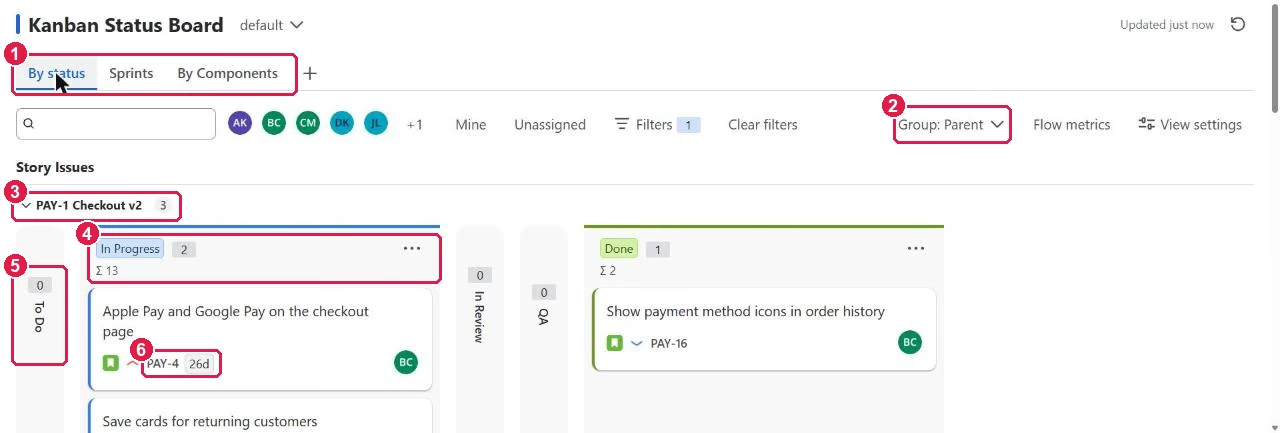
- The view tabs: By status, Sprints, By Components; + adds more.
- Group splits the board into lanes, here by Parent.
- Each lane is one parent with its number of issues.
- Each column is a status, with the number of issues and the sum of story points.
- Empty columns fold to a narrow strip.
- The grey badge on a card is its age in the current status.
- Each column is a status of the issue type’s workflow, coloured by its category (to do, in progress, done).
- Without a saved order, columns go To Do → In Progress → Done by category. Drag a column by its header, or use Move left / Move right in its menu; the order is the same on every issue type’s board of the project and is kept with Save.
- Statuses your workflow cannot reach from a card’s status are blocked while you drag (“No transition to …”) and greyed out in the card’s Move to menu.
- If a transition needs fields (a resolution, for example), the card goes back and the message names the field — open the issue to finish the transition there.
Move cards
Drag a card to another column, or open its ⋯ menu:
- Point at a card and click ⋯ (or drag the card to another column).
- Actions: open the issue, edit its summary, or select it for a group move.
- Rank within the column.
- Move to another status.
- Move to runs the transition, also from the keyboard.
- Rank (Jira Software sites): Move up / Move down, or drag inside the column, stores the issue’s rank in Jira — your Jira board shows the same order.
- Edit summary renames the issue (Enter saves, Escape cancels); View the issue opens Jira’s issue dialog. Click the avatar to change the assignee.
Move several issues and undo
Ctrl+click (⌘+click or Shift+click) cards, or Select them from their menus. The bar “N selected” offers Move to… and Clear selection.
Each issue is changed like a single move: one that Jira refuses goes back with the reason, the others move. Undo in the message — or Ctrl+Z (⌘Z) — reverses the last move, for every card in it.
WIP limits, swimlanes and column sums
- WIP limit — a column’s ⋯ → Set WIP limit…, a whole number from 1 to 999 (empty or 0 removes it). The header shows “cards / limit” and turns red over it. With swimlanes, “1 · 2 / 1” means 1 in this lane, 2 in all lanes, limit 1. Limits warn; they do not stop a move — as on Jira’s own boards.
- Board settings (the gear next to Refresh):
- Swimlanes — None, Assignee, Parent (epic), Priority or Project. Each lane has a title and count; click it to fold the lane. Columns keep one order in every lane, and a card moves within its lane.
- Column sums — issue count only, original or remaining estimate (hours), Story Points or any number field; Σ appears next to each column’s count. Done issues are not counted in remaining estimate.
- Card fields — Parent, Status, Due date, Labels, Components, Fix versions or Remaining estimate on every card.
- Auto-refresh — off, or every 1, 5, 15 or 30 minutes while the page is visible and nothing is being dragged.
Cards are marked Overdue, Due today, Due tomorrow or Due in N days (up to 3); Done issues get no mark.
Flow metrics: WIP aging and throughput
Days in status on the card. Every card in an in-progress status shows how many days it has spent in that status, all its stays added up (“24d”; “less than a day” for a new one). The chip compares the card with the project’s issues finished in the last 90 days:
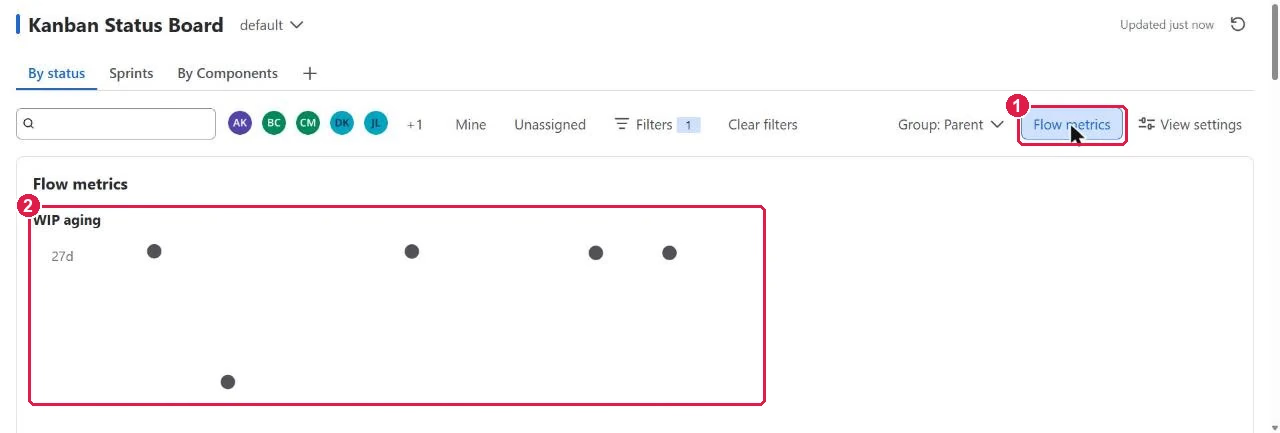
- Click Flow metrics.
- WIP aging shows a dot per open issue: higher means it has waited longer. Throughput below counts finished issues per week.
- amber — longer than half of them needed in that status;
- red — longer than 85 % of them needed;
- grey — fewer than five issues have finished, so there is nothing to compare with yet; the tooltip says so.
Flow metrics in the toolbar opens a panel above the board:
- WIP aging — one dot per card in progress, by status and age, with the 50 % and 85 % lines. Click a dot to open the issue.
- Throughput, last 12 weeks — issues finished per week, with the average, the last 4 weeks and this week so far.
On a narrow screen the charts keep their size and scroll inside the panel. Everything is worked out from Jira’s status history when the board opens, with your permissions, after the board is shown; nothing is stored. View settings → Flow metrics: age on cards, aging and throughput turns it off for the view.
Filters and quick find
Only my issues and Assignees are always visible; More filters opens Include statuses, Exclude statuses, Issue types, Priorities and Created after / before. Clear filters empties them.
Find by key or summary, Mine and Unassigned narrow the cards on screen at once and are not saved. A board loads up to 1,000 issues; if more match, the board says “Not every issue is shown”.
Profiles
The Profile select keeps named filter sets for this project; the board opens with default. Save stores the filters, column order, WIP limits and board settings (“Unsaved changes” shows until then). Type a new name into the select and choose Create profile ”…” to add one; ⋯ → Delete profile… removes one. Profiles are yours only.
Views for every way you work
The first tab, By status, is the board above. + (Add a view) adds By due date, By priority, By assignee, Workload, Sprints (Jira Software) and By field… — Labels, Components, Fix versions or a single-select field.
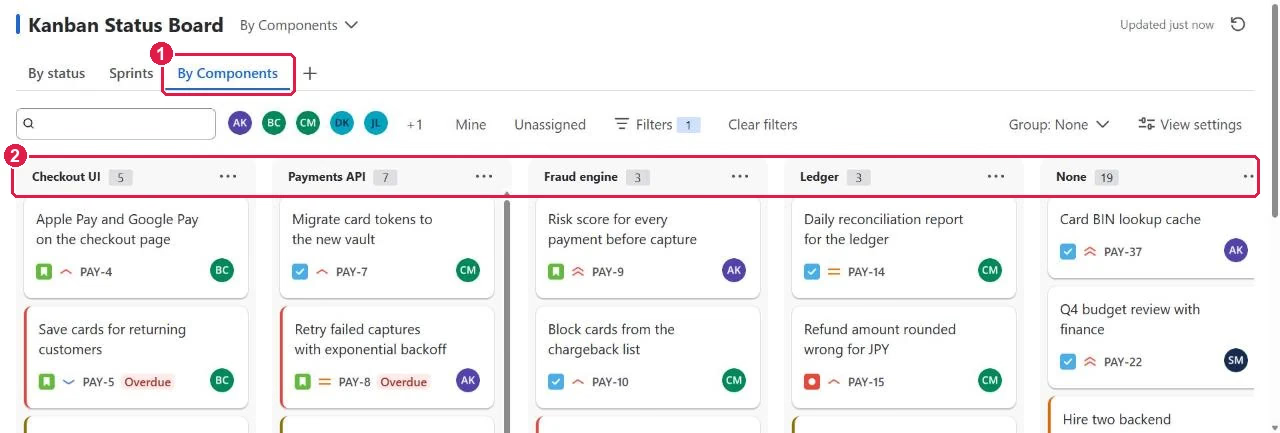
- Open a view tab such as By Components.
- The columns are now the project’s components; drag a card to change its component.
- On a By field board, dropping a card on another column replaces the value it was shown under; None removes it.
- The Sprints view shows a Scrum board’s Backlog, active sprint and future sprints; a drop moves the issue between them in Jira.
- An added tab has its own filters, saved with Save into the view.
- With a view selected, the ⋯ menu next to Save renames, moves or removes it, exports it, and shares it with the project:
Everyone who can open the project page finds a shared view under + → Shared views. Its owner and project admins can save changes for everyone; others can Save as my view. The address follows the selected tab, so a link opens that view.
Export to CSV saves the cards on screen with key, summary, column, status, priority, assignee and due date — the file is made in your browser.
Dashboard gadget
Add Kanban Status Board to a dashboard (Edit → Add gadget), and in Configure choose the board, the Project, the column sums and the refresh interval. The gadget lists issues per status with a bar for each column’s share:
The gadget searches Jira as the person viewing the dashboard.
Dark theme
The board follows Jira’s theme:
Keyboard
The cards are one Tab stop: ↑ / ↓ within a column, ← / → to the next column with issues, Home / End and Ctrl+Home / Ctrl+End to the first and last issue. Enter or Space opens the card’s menu; unreachable statuses are disabled there.
Saved views, Mine and View settings
Since the November 2026 redesign every board has the same frame:
- The saved view next to the app’s name (”· default ▾”): switch views, Save as new view…, Rename, Delete view… and share a view with the project or everyone. While the board differs from what is saved, Save changes and Discard appear.
- Quick filters next to Filters: Find issues, Mine and Unassigned.
- View settings — a panel beside the board: Group by (swimlanes), Column sums, Card fields with a live preview, WIP limits of every column in one list, and Auto-refresh. Every change shows at once and is kept with Save changes.
Permissions and data
- Issues stay in Jira. Transitions run through Jira’s REST API as you, with your workflow’s conditions and validators.
- Flow metrics read the issues’ status history (changelog) as you when the board opens and are not stored.
- Stored by the app: your profiles, view tabs and shared views, in the app’s Forge storage inside your Atlassian site. Nothing is sent outside Atlassian.
- Permissions: read and write Jira work, read users and groups, app storage, Jira configuration (to list group members), and Jira Software’s board, sprint and rank permissions for ranking and the Sprints view.
- On uninstall profiles and views are removed; the status changes stay in Jira’s history.
See the privacy policy.
Troubleshooting
- I can’t drop a card on a status — the workflow has no transition from the card’s status to it. Use another path, or ask a Jira admin to add the transition.
- ”… is required” after a drop — the transition has a screen with required fields. Open the issue and complete the transition there.
- An issue is missing — a filter hides it (Clear filters), or more than 1,000 issues match.
- “Issues could not be loaded: …” — press Retry. “Profiles could not be loaded” — Try again; nothing is lost.
Still stuck? Contact support.
Related apps
- Priority Board — the same board by priority, ranked like your backlog.
- Deadline Tracker — deadlines across projects, rescheduled by drag and drop.
- Workload & Capacity Planner — per-person load against weekly capacity.