PlantUML Diagrams: UML & C4 for Confluence – Guide
How to use PlantUML Diagrams for Confluence: UML and C4 diagrams from text on a page whiteboard, nomnoml class diagrams, the space page, history and export.
PlantUML Diagrams: UML & C4 for Confluence draws UML and C4 architecture diagrams on a Confluence page from a few lines of text, with the official PlantUML engine inside the app. Then you explain the model by hand on an Excalidraw whiteboard. In Confluence the app is called Excalidraw UML.
How to read the pictures. Every screenshot comes from a real Confluence site. The red boxes with numbers show where to look or click. Number 1 in the picture is step 1 in the text, number 2 is step 2, and so on.
Get started in 2 minutes
- Install PlantUML Diagrams: UML & C4 for Confluence from the Atlassian Marketplace. You need to be a Confluence admin. It is free for up to 10 users.
- Edit a page and type /Excalidraw, or open your space’s Excalidraw UML page and choose All diagrams → New diagram.
- The editor opens over the page: choose Insert diagram → PlantUML. The dialog opens with a ready example; press Insert.
- Save. The diagram shows on the page for everyone who can view it.
Add a diagram to a page
- Edit the page, put the cursor where the diagram should go and type /Excalidraw UML.
- Choose Excalidraw UML in the menu. You can also find it under + → Apps.
The editor opens at once, over the page. Draw, insert a diagram from text, then press Save and publish the page. Each macro is its own diagram, and a copy of the page gets its own copy of the diagram.
The space page: On this page and All diagrams
- In the space sidebar, under Space apps, click Excalidraw UML.
- The page has two tabs: On this page (the diagram shown on the space page) and All diagrams.
- New diagram draws a diagram that does not belong to one page.
- Narrow the list: All, Global (the whole site) or This space, sorted by Last edited. The search box finds a diagram by name.
- Each card shows a preview, where it lives, when it was edited and on which page it is shown. Its ⋯ gives Open, Edit and Show here (on the space page).
The global page (Apps → Excalidraw UML) lists every diagram on the site. Delete asks first: the diagram disappears from every page that shows it, so this cannot be undone.
PlantUML diagrams from text
- Name: the diagram’s name.
- Insert diagram ▾: choose PlantUML (second, after Nomnoml).
- Update ▾ lists the diagrams on the canvas by name; select one and the button becomes Update “its name”.
- History, Save and Close. Save is active only after a change.
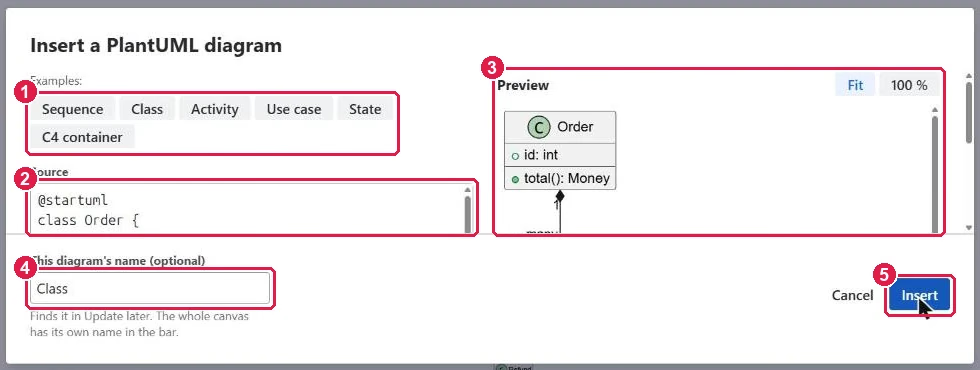
- Pick an example: Sequence, Class, Activity, Use case, State or C4 container.
- Edit the Source.
@startumland@endumlare optional, and labels can use any script, Cyrillic included. - The Preview redraws as you type.
- Give the diagram a name, so you find it in Update later.
- Press Insert.
Nomnoml is also in Insert diagram, first in the list: a very short way to write a class diagram, such as [Order|id;total: Money|refund(amount)]. The whole syntax, tested: nomnoml syntax.
Other diagram types in the same scene
Insert diagram also holds Mermaid, PlantUML, LaTeX Math, Graphviz, Vega-Lite (charts from data you paste; never from a URL) and WaveDrom (timing diagrams). Each dialog opens with an example and a field for the diagram’s name.
PlantUML and C4 diagrams
C4 is built in. !include <C4/C4_Context>, <C4/C4_Container>, <C4/C4_Component> and the other C4-PlantUML files, and the same files linked from GitHub (raw.githubusercontent.com/plantuml-stdlib/C4-PlantUML/…), are drawn from C4-PlantUML 2.14.0 inside the app. Any other !include is refused: “External includes are not supported: everything stays inside Atlassian.”
Errors. A mistake shows as a message with the line in your own text, for example “PlantUML: Syntax Error? (Assumed diagram type: sequence) on line 2.” Insert stays off until the text draws.
The editor: name, Insert diagram, update by name
The editor has one bar on top: the diagram’s Name, Insert diagram ▾, Update ▾, the save state (“Saved · version 2” or “Unsaved changes”), History, Save and Close. Update ▾ lists the diagrams on the canvas by name; select one on the canvas and the button becomes Update “its name”, and the dialog opens on its source.
Show a shared scene on a page
A shared scene is one diagram shown on many pages; a change to it shows on all of them. To show one in a macro, edit the page, open the macro’s settings and choose it under Scene (“Scenes of the whole site and of this space”). Leave Scene empty to keep the macro’s own diagram.
View settings
In the page editor, the macro’s View settings — max height (at least 120 px), Fit diagram, Match Atlassian theme, zoom and position — apply to everyone who views the page. Scroll inside the diagram lets the mouse wheel move the diagram; Ctrl/⌘ + wheel zooms. Readers can Expand the diagram and zoom with − / + / Fit.
Saving, history and conflicts
- Version history: History in the editor lists the last 10 saved versions. Restore saves an old version as a new one, so the current version stays in the list.
- Two people at once: if someone saved while you were editing, nothing is overwritten. Your changes stay in the editor and you choose to merge them with the latest version (for each shape the newer edit wins), reload, or save yours as a copy.
- Unsaved work survives a closed tab: the editor offers to restore it next time.
- Size: up to 5 MB per scene, images included; the meter in the editor shows how much is used.
PDF and Word export
Exporting the page to PDF or Word includes the diagram as it appears on the page — text diagrams, hand-drawn notes and charts.
Permissions and data
- Who can change a diagram: changing a macro’s diagram needs permission to edit the page; a space’s scenes need permission to create pages in that space. Everyone who can view the page sees the diagram.
- Scopes: the app asks only to read spaces and pages, and for its own storage.
- Where data lives: scenes, images and sources are stored in the app’s Forge storage inside your Atlassian site. Diagrams render in your browser; Mermaid, MathJax, Graphviz, Vega-Lite and the shape libraries ship inside the app — no PlantUML or other diagram server.
- PlantUML and C4: the PlantUML engine (
@plantuml/core1.2026.9) and C4-PlantUML 2.14.0 ship inside the app and load only when a PlantUML diagram is shown or edited. Nothing is fetched from plantuml.com, GitHub or any other server. - Cyrillic, Chinese and other scripts work; light and dark themes.
See the privacy policy.
Troubleshooting
- “No scene chosen” — edit the page, open the macro’s settings and choose a scene, or leave Scene empty and draw the macro’s own diagram.
- “The diagram could not be loaded.” — press Try again.
- Insert is disabled in a text dialog — the preview shows the error; fix the line it names.
- “This scene no longer exists” — the shared scene was deleted; choose another one.
- “Excalidraw needs an active licence” — a Confluence admin renews it in Manage apps.
Still stuck? Contact support.
Further reading
- nomnoml syntax: every arrow, shape and directive, tested — the full syntax this app renders (nomnoml 1.7.0), with the traps to avoid, such as arrowheads that change colour in SVG.
Related apps
- PlantUML Diagrams: UML & C4 for Jira – Excalidraw — the same app for Jira.
- Excalidraw Whiteboard & Mermaid Diagrams for Confluence — Mermaid first.
- Excalidraw Math Equations & LaTeX Whiteboard for Confluence — LaTeX Math first.
- Excalidraw Architecture & Sequence Diagrams for Confluence — Graphviz first.