Why Training Alone Does Not Prevent Secret Leaks
The engineer knew the rule
The incident review ends with “remind developers not to commit secrets.” Everyone in the room
already knew that rule. The credential was committed because the approved delivery path was not
available in the failing build, a local .env copy was the fastest workaround, and nobody
noticed before push.
That is a workflow failure expressed through a human action.
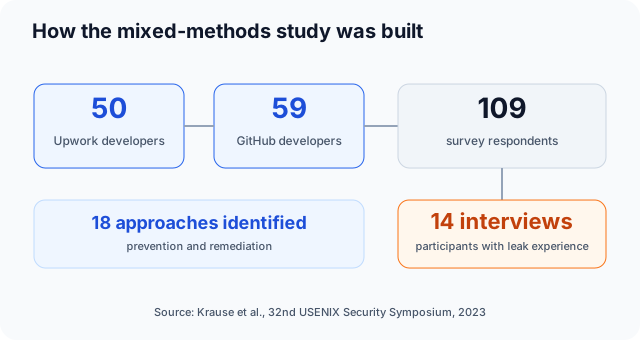
At the 2023 USENIX Security Symposium, researchers published Pushed by Accident: A Mixed-Methods Study on Strategies of Handling Secret Information in Source Code Repositories. They surveyed 109 developers with version-control experience: 50 freelancers recruited from Upwork and 59 GitHub developers. They then conducted 14 semi-structured interviews with developers who had experienced secret leakage.
In the survey, 30.3% reported first-hand experience with secret leakage. The researchers identified 18 prevention and remediation approaches and highlighted challenges including estimating risk and the need for controls with low adoption requirements.
Read the sample before repeating the percentage
The 30.3% result describes this study’s respondents, not all software developers. GitHub participants were recruited from users with public contact addresses; Upwork participants were screened for version-control collaboration experience. The interview sample deliberately included only people who had experienced a leak. Those choices are appropriate for the research questions but prevent a universal prevalence claim.
The study’s strength is methodological depth: a survey across two recruitment populations, interviews focused on real incidents, iterative qualitative coding, and a published replication package. Its most actionable output is the pattern of friction and remediation needs, not a headline percentage.
Training supplies knowledge; systems shape behavior
A policy can explain why plaintext credentials are dangerous. It cannot:
- stop a supported token before it is committed or pasted into a ticket;
- give a new teammate access to approved configuration;
- determine which services depend on a credential during rotation;
- invalidate an exposed token;
- distinguish a safe documentation placeholder from a usable private key.
Use training for threat recognition and response rehearsal. Use tooling for repeatable controls. If the safe path requires a new cloud account, manual key distribution, or waiting for one administrator, developers will create an unofficial path when production is blocked.
Design for the moment of pressure
Three properties matter more than another annual slide deck.
Low adoption cost. envseal keeps encrypted .env values in the git workflow,
assigns access to recipient keys, and injects values at runtime. It is not the right architecture
for every dynamic cloud secret, but it gives teams using file-based configuration a safer path
that still resembles their existing work.
Immediate containment. Secret Sentinel scans Jira and Confluence content where incident pressure often produces plaintext copies. Supported findings are redacted in place; high-risk findings can become assigned Jira incidents rather than an instruction in a policy nobody is reading at 02:00.
A complete remediation state. Redaction stops further casual exposure, but the credential must still be revoked or rotated, consumers updated, and the old value proven unusable.
Training remains useful when it teaches this system: which safe path to use, what an alert means, who owns rotation, and when an incident is actually closed. The research argues for helping developers adopt and recover—not for treating humans as a control that should never fail.
Frequently asked questions
Does security training have no value for preventing credential leaks?
Training builds recognition and shared language, but it cannot enforce a control or remove workflow friction. Pair it with low-adoption-cost delivery, automated detection, and a tested remediation path.
What does low adoption cost mean in practice?
The safe option should fit the tools and steps developers already use, require little new infrastructure, provide immediate feedback, and make remediation clear when prevention fails.