How to Test Secret Detection Without Live Credentials
A scanner test must not manufacture a leak
Generating a cloud key, pasting it into Jira, and planning to delete it afterward is not realistic testing. It is a real exposure with an optimistic cleanup step. Use a vendor-documented synthetic fixture whose shape exercises the detector but whose value cannot authenticate.
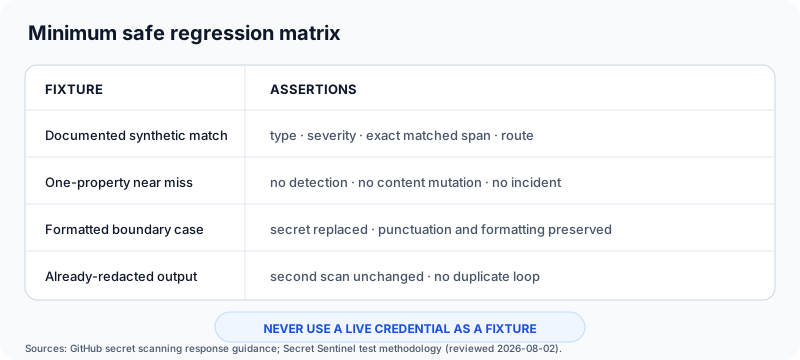
Build a four-fixture minimum suite
- Positive fixture: a documented synthetic value expected to match.
- Near miss: change one structural property so it must not match.
- Boundary fixture: place the value beside punctuation, in a code block, and inside formatted text; assert that only the secret span changes.
- Idempotency fixture: scan the already-redacted result again; it must remain unchanged and must not create an endless incident loop.
For each fixture, specify expected type, severity, replacement text, surrounding content, incident behavior, and whether an administrator override applies. A screenshot is useful evidence, but a table of inputs and expected outputs is the reproducible artifact.
Separate detector safety from fixture safety
A fake-looking string can accidentally conform to a real provider’s credential space. Prefer fixtures published by the scanner or provider and clearly label them as non-authenticating. Never test in public content. Use a sandbox with the smallest necessary audience and remove the test content afterward even when it is synthetic, so it cannot become misleading operational history.
GitHub’s secret scanning documentation describes multiple scanned surfaces and advises immediate credential rotation when a real leak is found. That response rule matters in testing: if anyone accidentally supplies a live value, stop the test, revoke it first, and only then clean up the content.
Test the surrounding system, not only the regex
Detection can succeed while the product fails: a redactor may damage rich text, two update events may open duplicate incidents, an exclusion may suppress redaction when it should suppress only escalation, or a custom regex may consume unbounded CPU. Test the complete content lifecycle.
Secret Sentinel’s documentation includes copy-paste synthetic examples, and its methodology explains the detector layers. Custom patterns use a linear-time RE2JS engine; the product’s Trust Center records that claim alongside its source-derived limitations.
Before installing, the safe Secret Scanner Lab lets reviewers inspect five precomputed cases taken from the real automated suite. It accepts no arbitrary text and ships no production detection code to the browser.
Preserve a regression artifact
Store the fixture name, synthetic input, expected result, product edition, date, and reviewer—never a live secret. Re-run the same suite after rule, scope, or incident-routing changes. The goal is not to prove a scanner “works” once; it is to make behavior observable when the system evolves.
Frequently asked questions
Is a revoked production key safe to use as a scanner fixture?
Prefer a documented synthetic value. A revoked key can retain identifying metadata, be copied into logs, or be mistaken for an active incident later.
What should a scanner regression suite test besides detection?
Test non-matches, exact redaction boundaries, formatting preservation, idempotency, duplicate handling, severity, and incident routing.