SOC 2 and Your Confluence/Jira Data: What Auditors Actually Look For
The scope question compliance teams get wrong
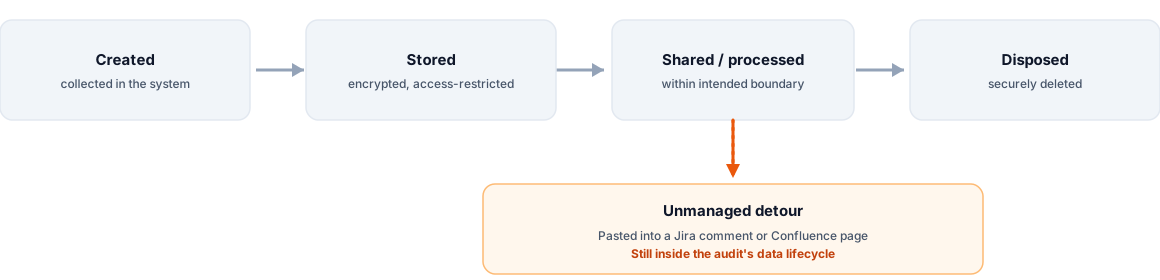
Ask most engineering teams what’s in scope for a SOC 2 audit and they’ll describe infrastructure: the production database, the cloud environment, maybe the CI pipeline. That’s necessary but incomplete. SOC 2’s Confidentiality Trust Services Criterion is scoped to data, not to a system boundary — and it explicitly covers that data “across its entire lifecycle, from creation/collection until disposal.” If a credential or a customer record gets pasted into a Jira comment while someone debugs a production issue, that comment is now part of the lifecycle the audit cares about, whether or not Jira was ever meant to be where that data lives.
What the criterion actually requires
The Confidentiality category breaks into two linked controls. C1.1 is data classification — identifying which data is confidential and how it needs to be handled. C1.2 is protection — encryption, access restriction, and secure deletion, applied consistently across that data’s full lifecycle. Both controls are evaluated on evidence of what actually happened, not on a written policy alone — a SOC 2 Type II audit specifically tests whether the control operated correctly over the audit period, not just whether it exists on paper.
Where it actually breaks down
Compliance guidance is unusually direct about the specific failure mode here. One widely-used SOC 2 confidentiality explainer describes it as a recurring, named gap: “confidential records end up in tickets, spreadsheets, lower environments, screenshots, and chat threads.” It’s not framed as a hypothetical risk — it’s framed as something that happens routinely, usually because someone solving a problem under time pressure copies real data into whatever tool is in front of them, without treating that copy as a data-handling decision at all. A wiki and an issue tracker are exactly the tools in front of people during that kind of troubleshooting.
What auditors actually ask to see
For the Confidentiality criterion specifically, expect requests for: a data classification policy and evidence it’s applied; proof that access to confidential data is restricted, not just documented as restricted; and — the part teams most often miss — evidence of ongoing monitoring for confidential data landing somewhere it shouldn’t, with a documented remediation path when it does. The secret lifecycle your Jira workflow is missing covers what that remediation path needs to include beyond “someone noticed and deleted it.”
What a real evidence package looks like
A SOC 2 Type II audit period typically runs three to twelve months, and auditors test whether a control operated throughout that window — a screenshot from the week before the audit doesn’t satisfy that. For the Confidentiality criterion as it applies to Jira and Confluence, a defensible evidence package generally needs four distinct artifacts:
- The policy — a written data classification policy stating what counts as confidential and how it must be handled, dated and version-controlled.
- The configuration — proof of what’s actually scanned and enforced: which spaces, projects, and content types are covered, and since when, not just that a feature exists.
- The operating log — a dated record spanning the full audit period: what was detected, when, its classification, and what happened to it. A single point-in-time export doesn’t demonstrate the control ran continuously; a log with entries distributed across the whole period does.
- The remediation trail — for each finding, evidence the underlying credential or data was actually rotated or handled at its source, not just that the visible copy was removed. Redaction and revocation are different actions, and an auditor testing this control specifically wants to see both steps, connected to the same finding.
Auditors don’t need a specific product to produce this — a policy document, a configuration export, and a manually maintained spreadsheet can satisfy the same requirements. What matters is that all four artifacts exist, are dated, and cover the full period, which is exactly where manual processes tend to have gaps: a spreadsheet nobody updated for two months during the audit period is a two-month hole in the operating evidence, discovered during testing rather than before it.
Redaction is evidence, not the whole control
Finding and redacting an exposed credential in Confluence or Jira doesn’t complete C1.2 on its own — deleting or redacting a leaked secret doesn’t revoke it, so the credential still needs rotation at its actual source. But a timestamped record of what was found, when, and what happened next is precisely the operating evidence an auditor is looking for — proof the control ran continuously over the audit period, not just that a policy document mentions it.
Secret Sentinel scans Confluence pages and comments and Jira issues and comments continuously, redacts what it finds in place, and its Advanced edition adds a compliance dashboard specifically for producing that kind of ongoing-monitoring evidence. It doesn’t replace credential rotation or a data classification policy — nothing automated does — but it directly addresses the gap the guidance above names: confidential data moving into a system built for conversation, not for confidentiality, and nobody noticing until an audit asks.
Frequently asked questions
Is Confluence or Jira actually in scope for a SOC 2 audit?
Yes, if confidential data ends up in them — and the Confidentiality Trust Services Criterion is defined by the data's full lifecycle, not by which system it's supposed to live in. A credential or customer record pasted into a Jira comment during troubleshooting is inside that lifecycle the moment it's pasted, regardless of whether Jira was the "official" system of record.
What does the SOC 2 Confidentiality criterion actually require?
Two linked controls — C1.1, classifying which data is confidential and how it should be handled, and C1.2, enforcing protection like encryption, access restriction, and secure deletion across that data's entire lifecycle, from creation through disposal.
What's the most common way this control actually fails in practice?
Confidential data getting copied into a system that wasn't designed to protect it. Compliance guidance describes this directly as a recurring gap — confidential records ending up in tickets, spreadsheets, lower environments, screenshots, and chat threads, usually because someone was solving a problem quickly and didn't think of it as a data-handling decision.
Does redacting a found secret in Confluence or Jira satisfy the Confidentiality criterion by itself?
Not by itself — the credential still needs to be rotated at its source, since redaction removes the visible copy but not the credential's validity. But a timestamped, logged finding-and-redaction record is exactly the kind of evidence an auditor looks for to demonstrate the control is actually operating, not just documented on paper.