A Practical Guide to Rotating Credentials After a Leak
The gap between “found it” and “fixed it”
Finding a leaked credential is the easy part — a scanner flags it, a teammate notices it in a code review, someone stumbles on it in an old Jira comment. What happens in the hours or days after that is where most organizations actually lose ground: the credential sits there, still valid, while someone figures out who owns it, whether it’s safe to just rotate, and what else might break if they do.
What the data says about that gap
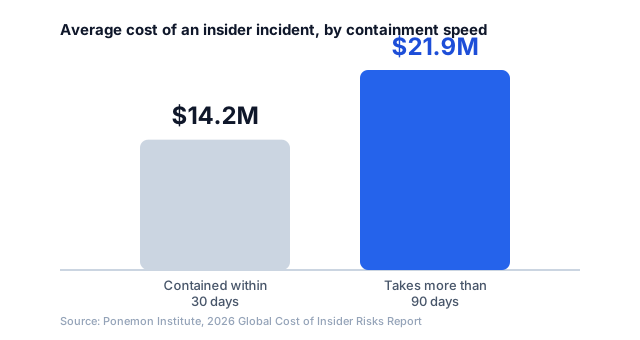
The Ponemon Institute’s 2026 Global Cost of Insider Risks report quantifies exactly what that delay costs: incidents contained within 30 days average $14.2 million, while incidents that take more than 90 days to contain average $21.9 million — a 54% increase for the slower response. Credential theft specifically carries its own average per-incident cost of $842,462. Neither number moves because someone found the problem late; they move because of how long it took to actually close it out once found.
A concrete order of operations
1. Rotate before you investigate, not after. The instinct to “figure out the blast radius first” is understandable but backwards — every hour a live credential stays valid is an hour it can still be used. Rotate immediately, then investigate what happened with the old one.
2. Prioritize by what the credential can actually do. A production database credential or an admin-scoped API key goes first, ahead of a read-only or low-privilege token, regardless of which was “found” first. If several leaked at once, triage by blast radius, not by discovery order.
3. Assume it was seen, don’t wait to confirm it. Especially for anything posted in a shared tool — a Jira comment, a Confluence page — there’s rarely a reliable way to determine exactly who read it before it was caught. Treat “posted somewhere with more than one viewer” as “seen.”
4. Update everywhere the old value is still hardcoded. A rotation that isn’t propagated to every service using the old credential just trades a security incident for an outage. Search config files, CI/CD pipeline variables, and any documentation someone might copy-paste from before calling it done.
5. Check logs for the exposure window, not just going forward. Rotating stops future abuse. It says nothing about what happened during the time the old credential was valid and exposed. Pull access logs for that window before closing the incident out.
6. Write down what actually happened. Not for blame — for the next person who has to do this. Which credential, how it leaked, how long it took to rotate, what broke when it did. That record is what makes the next incident faster to contain, and per the data above, faster containment is worth a great deal.
Closing the gap before it opens
Steps 1 and 3 above depend on actually finding the leak quickly in the first place — and specifically for Confluence and Jira, that’s the part most teams have the least visibility into. Secret Sentinel scans both continuously and can automatically open a tracked Jira incident the moment a high-risk credential shows up, with the assignee and priority already set — turning “someone eventually notices” into a starting gun that fires the moment the leak happens, not whenever someone happens to scroll past it.
Install Secret Sentinel for Confluence · Install Secret Sentinel for Jira
Frequently asked questions
How much does containment speed actually matter, in dollar terms?
A lot. The Ponemon Institute's 2026 Cost of Insider Risks report found incidents contained within 30 days average $14.2 million, versus $21.9 million for incidents taking more than 90 days — a 54% cost increase for slower response.
What's the average cost of a credential-theft incident specifically?
Ponemon's research puts the average per-incident cost of credential theft at $842,462 — a distinct, specific figure from the broader containment-speed numbers, which cover insider risk incidents overall.
What should I rotate first if I find multiple exposed credentials at once?
Whichever one grants the most access if abused — a production database or admin API key before a low-privilege read-only token — and anything already confirmed to have been viewed or downloaded by someone outside the intended audience.
Does rotating the credential mean the incident is over?
No. Rotation stops future abuse but doesn't undo anything already done with the old credential. Check logs for the exposure window before declaring the incident closed, and update wherever the old value was still hardcoded so the rotation doesn't just break your own systems.