GitHub Secret Scanning vs Jira Secret Scanning
The leak moved with the conversation
A developer never commits a production token. They paste it into a private Jira incident so the on-call engineer can reproduce an outage. Repository controls worked exactly as designed—and never saw the credential, because it crossed a different system boundary.
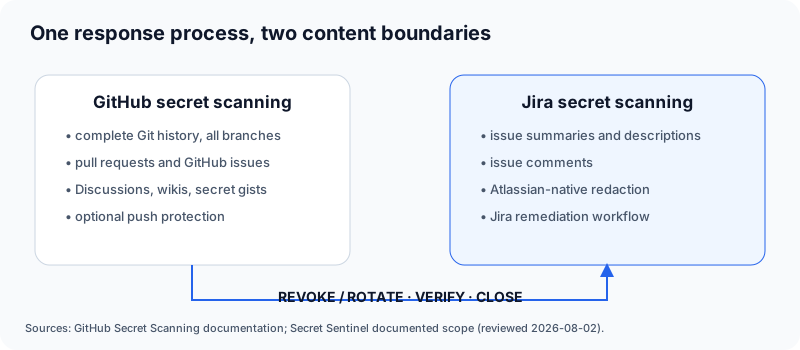
GitHub’s scope is broad inside GitHub
GitHub’s official secret scanning documentation says it scans complete Git history on every branch and also scans GitHub issue titles, descriptions and comments, pull requests, Discussions, wikis, and secret gists. Push protection can stop supported secrets before a commit is accepted. That is substantially more than a periodic grep of the default branch.
The boundary is still GitHub. A Jira issue, Confluence runbook, Slack message, local .env file,
or vendor ticket does not become part of GitHub’s corpus merely because the same engineering team
uses both systems.
Compare trust boundaries, not product names
| Question | GitHub secret scanning | Jira secret scanning |
|---|---|---|
| Primary corpus | Git history and GitHub collaboration surfaces | Jira issue text and comments |
| Prevention point | Can block supported secrets at push | Acts when supported Jira content is created or updated |
| Native response | Repository security alert and GitHub remediation workflow | Redaction and a Jira-native remediation item, depending on product |
| Blind spot addressed by the other | Operational content outside GitHub | Repository history and pre-push workflow |
This comparison is about coverage, not superiority. GitHub can validate some partner-pattern credentials and rescan history when new types are added. A Jira-native app can redact a matched span in the operational record and route ownership through the workflow already used by the team.
Build one response process across both
Normalize four fields from either source: credential type, environment, owner, and revocation status. Treat removal from text as containment, not remediation. GitHub itself advises immediate rotation after an alert; the same rule applies when the source is Jira.
Secret Sentinel supplies the Jira and Confluence layer while keeping
processing within Atlassian Forge; its exact scope and stored data are documented in the
Trust Center. envseal addresses a third boundary: authorized sharing of
encrypted .env values in git. Together they form separate controls for separate leak paths—not
one oversized tool with an ambiguous promise of “complete coverage.”
Frequently asked questions
Does GitHub secret scanning make a Jira scanner redundant?
No. GitHub covers repositories and GitHub collaboration surfaces; Jira content is a separate system and trust boundary.
Should teams disable GitHub scanning after installing a Jira scanner?
No. The controls are complementary. Keep repository prevention and detection, then cover Jira and Confluence where operational work happens.