Common Types of Leaked Credentials (and the Fastest-Growing One)
The credential you’re picturing is probably wrong
Ask most engineers what a “leaked credential” looks like and you’ll get the same answer: an AWS access key, maybe a GitHub token. Both are real, common, and worth catching. But they’re also the easiest case — well-known formats, easy to pattern-match, easy to validate by just asking the provider’s API “is this key still live?”
The actual data tells a messier story, and it’s worth knowing about before you pick — or trust — a scanning tool.
The fastest-growing leak category isn’t cloud keys — it’s AI
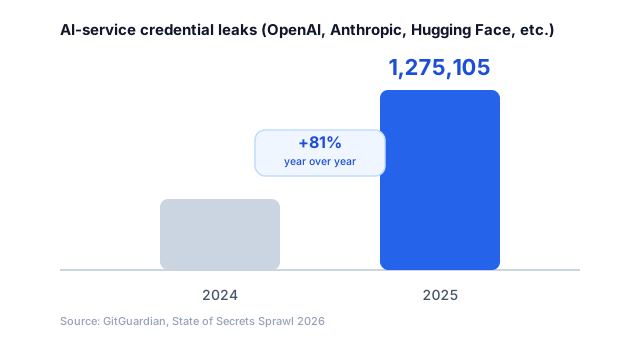
According to GitGuardian’s State of Secrets Sprawl 2026 report, AI-service credential leaks — OpenAI, Anthropic, Hugging Face, and similar — grew 81% year over year, reaching over 1.27 million leaked secrets in 2025. Eight of the ten fastest-growing leak categories that year were tied to AI services, and LLM infrastructure tokens specifically leaked five times faster than core model-provider keys.
This tracks with how fast teams have adopted AI tooling: a new API key gets generated for every project, every prototype, every internal script calling a model — and, like any other credential, it gets pasted somewhere convenient. A Jira ticket documenting “here’s the key I used to test this,” a Confluence page with a working code sample, a comment on a bug report. None of that is unusual. It’s exactly how the previous generation of cloud keys leaked too — the pattern just moved to a newer category of secret.
Why “we validate our keys” isn’t the whole answer
A lot of scanning tools lean on validation: find something that looks like a key, then call the relevant provider’s API to confirm it’s actually live before flagging it. That’s a genuinely useful signal — it cuts down on false positives for well-known formats. But the same GitGuardian report found that 46% of critical secrets are missed by validation-only prioritization.
The reason is straightforward: validation only works for credential types with a provider
API to check against. A private key, an internal service’s custom token format, a
plain password= assignment in a config snippet — none of these can be “pinged” to see if
they still work. A tool that only trusts what it can validate quietly ignores almost half
of what actually matters. Severity needs to come from context — is this a paired,
usable secret or a harmless identifier — not just from whether an API call succeeded.
What’s actually out there
Real leaks aren’t limited to one or two categories. Here’s the breadth of credential types that show up in practice across cloud infrastructure, developer tools, and everyday SaaS:
| Category | Examples |
|---|---|
| Cloud infrastructure | AWS access/secret keys, GCP service account key files, HashiCorp Vault tokens |
| Developer platforms | GitHub tokens (classic & fine-grained), GitLab personal access tokens |
| AI & ML platforms | OpenAI, Anthropic, Groq, and Hugging Face API keys |
| Databases | MongoDB, MySQL, and PostgreSQL connection strings |
| Payments & commerce | Stripe secret/restricted keys, Shopify API keys, SendGrid keys |
| Collaboration & productivity | Slack tokens & webhooks, Notion tokens, Linear API tokens, Figma tokens |
| DevOps & hosting | Vercel tokens, Cloudflare API keys, Docker tokens, Grafana tokens |
| Generic & cryptographic | SSH/PEM private keys, JSON Web Tokens, npm tokens, basic-auth credentials |
That last row — generic and cryptographic secrets — is exactly the category
validation-only tools tend to miss, and it’s a big one: private keys and bare tokens don’t
announce which service they belong to the way an sk_live_... Stripe key does.
The part nobody fixes on their own
Even when a leak is found, it often isn’t rotated. The same report found that nearly 70% of credentials confirmed valid in 2022 were still valid in January 2025 — and when retested a year later, the rate was still above 64%. A credential doesn’t get safer with age; it just sits there, waiting.
That’s an argument for detection that escalates, not just detection that logs a finding somewhere. A dashboard nobody checks doesn’t rotate a key. A Jira incident assigned to someone, with a due date, has a much better chance of actually getting fixed.
Where this leaves you
If you’re evaluating how well-covered your team actually is, it’s worth checking two things: whether your scanning covers credential types beyond the easily-validated ones (private keys, internal tokens, AI service keys), and whether a real finding turns into something a person is actually responsible for closing out.
Secret Sentinel scans Confluence and Jira for 50+ credential types — including OpenAI, Anthropic, Groq, and Hugging Face keys alongside the more familiar cloud, database, and payment provider formats — classifies findings by real exploitability rather than validation alone, and can automatically open a tracked Jira incident for anything high-risk.
Install Secret Sentinel for Confluence · Install Secret Sentinel for Jira
Frequently asked questions
Are AI service API keys (OpenAI, Anthropic, Hugging Face) actually a common leak target?
Yes, and increasingly so — GitGuardian's State of Secrets Sprawl 2026 report found AI-service secret leaks grew 81% year over year to 1,275,105 in 2025, with 8 of the 10 fastest-growing leak categories tied to AI services.
If my scanner validates that a key still works, am I covered?
Not entirely. The same report found that 46% of critical secrets are missed by validation-only prioritization — generic credentials like private keys, internal tokens, and passwords can't be auto-validated by pinging an API, so a tool that only flags "confirmed live" keys misses a large share of real risk.
Why do leaked credentials stay valid for years instead of getting rotated?
Mostly because nobody notices. Nearly 70% of credentials confirmed valid in 2022 were still valid in January 2025, and the rate was still above 64% a year later — rotation happens when a leak is found and escalated, not on its own.
Does Secret Sentinel detect AI service keys specifically?
Yes — OpenAI, Anthropic, Groq, and Hugging Face API keys are among the 50+ credential types Secret Sentinel scans for in Confluence and Jira, alongside cloud, database, and payment provider credentials.