How to Build a Jira Security App Approval Case
“We need this app” is not an approval case
An administrator receives a Marketplace request with a link and one sentence: “Security wants this installed.” The reviewer must now discover the problem, scope, data path, permissions, test plan, and owner. Deferral is rational because the request transferred all uncertainty to the approver.
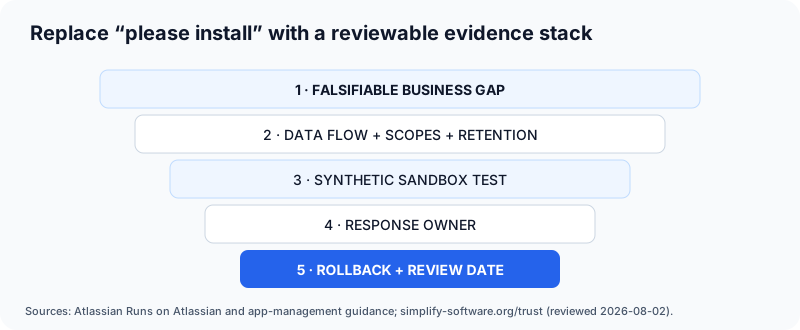
Define the gap in one falsifiable sentence
Use: “Repository controls do not inspect credentials pasted into Jira issue descriptions and comments.” Avoid: “We need better security.” A falsifiable gap tells the admin which content the app needs and which test would show that it works.
Attach architecture evidence before feature evidence
The decision packet should answer: where code runs, where content is processed, every egress domain, persistent fields, logging, uninstall retention, and vendor support access. Then map every requested scope to one necessary feature.
Atlassian’s Runs on Atlassian program provides a useful verified signal for Atlassian-hosted compute/storage and egress eligibility, but Atlassian explicitly describes a shared-responsibility boundary. Pair the badge with the vendor’s data-flow and limitations. Secret Sentinel publishes both in its Trust Center.
Propose a reversible experiment
Request a sandbox trial, not immediate production-wide trust. Name synthetic fixtures, expected redaction, accepted false-positive behavior, incident routing, and exit criteria. Never create a live credential for the test. Record which administrator can change exclusions and who owns revocation after a genuine detection.
Atlassian documents installation consent and Connected Apps management in its admin guidance. Organizations with the relevant controls can additionally restrict app access using data security policies. Those controls belong in the rollout plan rather than being discovered afterward.
Make the decision auditable
The final record should allow three outcomes: approve, approve with constraints, or reject. Preserve the listing URL, edition, review date, scope table, evidence links, sandbox result, data owner, security contact, and next review date. State the residual risk: scanners are pattern-based and redaction is not credential rotation.
For Secret Sentinel, start with the downloadable security review pack and paste the relevant admin request. That does not guarantee approval; it makes the actual decision small enough to evaluate.
Frequently asked questions
What makes an app request easy for an Atlassian admin to approve?
A bounded use case, exact permissions and data flow, named test criteria, an operational owner, and a rollback plan.